
Why DML Technology is the “ROI King” of RF Transmission?
By the year 2026, the telecommunications industry will have a single goal, which is to provide connectivity that is unbroken, irrespective of place. Situations are changing with time, especially as 5G-Advanced (5.5G) transitions from experimentation to a commercial trip and VLEO/ satellite constellations providing intensive global coverage. A huge gap is presented to the industry. This is how we send high-frequency band, wideband radio signals over distances without the attenuation impacts presented by the constraints of the conventional cables being used.
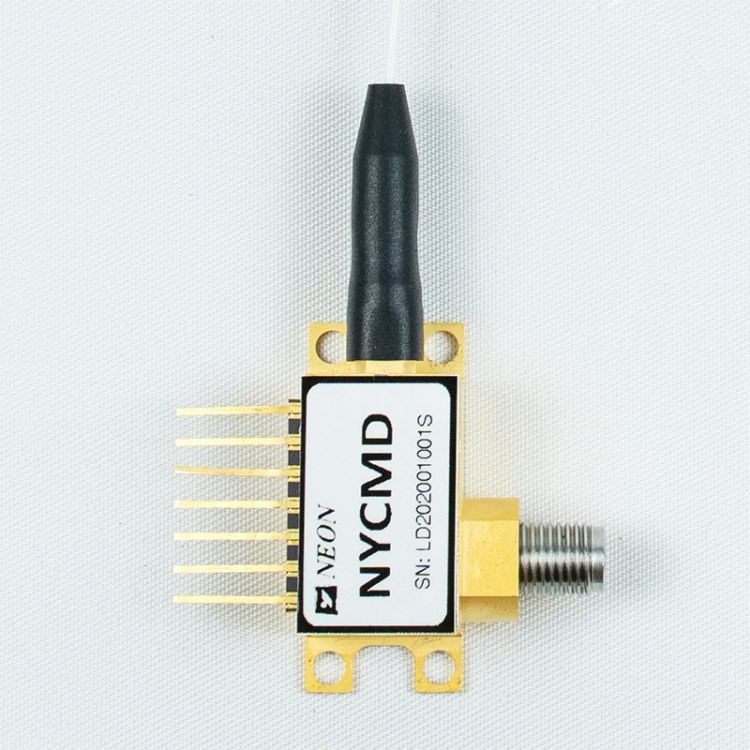
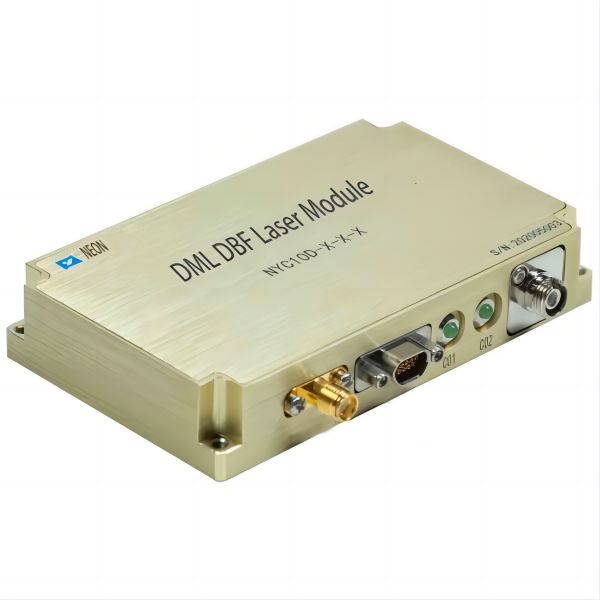
The answer lies in the evolution of Radio over Fiber (RoF) technology, specifically driven by the resurgence of the DML transmitter (Directly Modulated Laser). Among the various optical solutions, the DML DFB laser—exemplified by high-performance modules like the NYC04D series—has emerged as the “Return on Investment (ROI) King” for next-generation infrastructure.
The Connectivity Gap: Bridging 5G-Advanced and Satellite Ground Stations with Antenna Remoting
Reconfiguration from 5G to 5.5G does not mean faster speeds, but involves more of higher frequency bands (including Millimetre Wave and a few upper mid-bands) and Integration of Sensing and Communication (ISAC). In parallel, the interconnection of satellite-ground networks necessitates earth stations to deal with extremely accurate and high-speed data throughput.
In these scenarios, the usage of coaxial cables in connecting the antennas to Baseband Units (BBUs) or satellite modems can be obviated. The reason behind this is that above the 3G threshold, the loss in coaxial signal becomes massive and the cords are very large, as to be susceptible to electro-magnetic interference.
Try Antenna remoting. It refers to the technology of RF to optical conversion, which works at the source and allows for data transmission over long distances of light and thin optical fiber with more or less zero loss. The heart of this conversion is a DML transmitter modulator, which is being touted as the most cost- and energy-effective driver for the digital transitions that are taking place currently.
DML DFB Laser Technology: High Dynamic Range for Broadband Wireless Communications
Exploring the inner workings of a DML DFB Laser allows us a better albeit small insight as to why. For example, while an EML laser requires the user to have a fast and accurate source of laser and a separate modulator, directly modulated lasers do not require this extensive equipment, as light intensity can be controlled by adjusting the current being injected.
The NYC04D Series: A Case Study in Precision
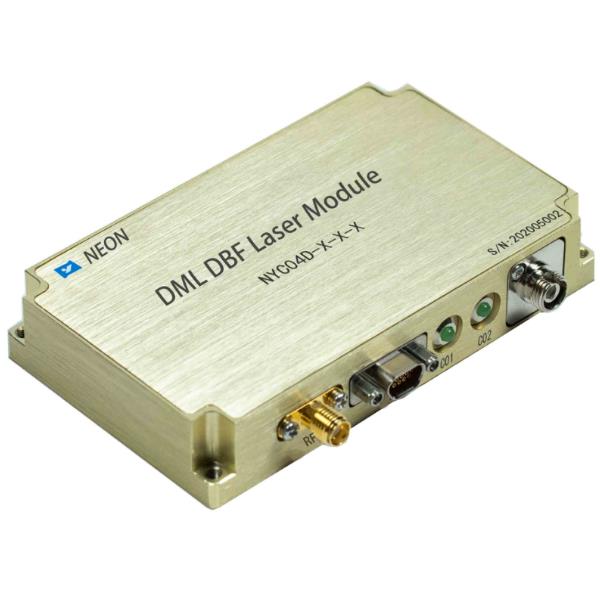
For Broadband Wireless Communications, not any DML will suffice. The NYC04D series DML DFB transmitter is specifically engineered for analog RF applications. Its technical superiority stems from three key pillars:
- Wide Frequency Response: With a modulation bandwidth reaching 4GHz and beyond, it comfortably covers the L-band, S-band, and the majority of 5G sub-6GHz frequencies. This makes it a “universal donor” for both cellular and satellite ground station equipment.
- High Dynamic Range (SFDR): In analog transmission, the Spurious-Free Dynamic Range is the ultimate metric. A high SFDR ensures that the laser can handle a strong signal without distorting (clipping) while still being sensitive enough to carry weak signals above the noise floor.
- DFB Stability: The Distributed Feedback (DFB) structure incorporates a grating into the laser’s active region, ensuring a single longitudinal mode output. This provides the narrow spectral width necessary to minimize chromatic dispersion over long fiber runs.
DML vs. EML: Why DML is the Most Cost-Effective Choice for 5G-Advanced Edge Networks
In the telecommunications industry, technology wins not just on performance, but on the SWaP-C metric: Size, Weight, Power, and Cost.
1. Cost-Effectiveness
EML and Mach-Zehnder Modulator (MZM) systems offer high performance but at a premium price point. For the densified networks required by 5.5G—where the number of small cells and remote radio heads (RRH) will increase by 5x—the cost of optics becomes a primary bottleneck. The DML transmitter provides a significantly lower bill-of-materials (BOM), allowing for massive scale-out without exponential budget increases.
2. Power Efficiency
DMLs do not require the high-voltage drivers or the complex temperature stabilization (in some uncooled versions) that external modulators demand. In an era where “Green Data Centers” and carbon neutrality are regulatory mandates, the lower power consumption of DML-based RoF links directly translates to lower Operational Excellence (OPEX).
3. System Simplicity
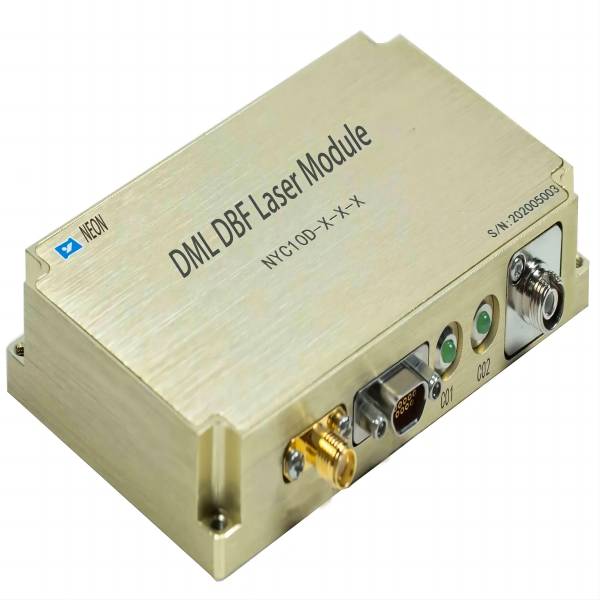
The integration of the modulation and light emission into a single chip reduces the footprint of the optical sub-assembly (OSA). This allows for more compact Antenna Remoting units that can be easily mounted on street lamps, utility poles, or compact satellite terminals.
Key Applications of DFB Lasers: From 5.5G Small Cells to Satellite Ground Station Remoting
1. 5G-A Distributed Antenna Systems (DAS)
In high-density environments like stadiums, airports, and smart factories, 5.5G requires a massive number of indoor antennas. Using DML DFB lasers to distribute the signal via fiber ensures high throughput and low latency, supporting the “deterministic networking” required for industrial automation and AI-driven robotics.
2. Satellite Ground Station Extension
Satellite dishes are often placed in “radio silent” zones, far from the central control room to avoid interference. The NYC04D series enables the L-Band signal from the satellite LNB (Low Noise Block) to be transported over kilometers of fiber to the indoor receiver without degrading the Signal-to-Noise Ratio (SNR).
3. Public Safety and Emergency Broadband
In disaster recovery, rapid deployment of wireless coverage is essential. Portable RoF systems using DML transmitters allow emergency responders to set up high-bandwidth “bubbles” by quickly tethering remote antennas to a central hub via ruggedized optical cable.
How High-Linearity DFB Lasers Future-Proof 6G and Beyond
Critically, the historical weakness of DML—frequency chirp and dispersion—is being mitigated by modern DSP (Digital Signal Processing) and improved laser fabrication. By optimizing the DFB Laser cavity design, companies like NeonCQ have pushed the effective transmission distance of DMLs to a point where they satisfy 95% of 5G-A and satellite backhaul requirements (typically <10km).
As we look toward 2026 and the eventual transition to 6G, the industry is witnessing a “DML Renaissance.” The focus is no longer just on raw speed, but on the linearity and stability of the optical link. The NYC04D series represents this shift, providing a robust platform for analog-to-optical conversion that meets the rigorous demands of modern RF engineering.
FAQ
Q1: What is the main advantage of a DML DFB Transmitter in 5.5G networks?
It provides a high-performance, low-cost solution for Antenna Remoting. Compared to EML, a DML Transmitter is more power-efficient and cost-effective for short-to-medium distance RF signal distribution in 5.5G DAS and small cells.
Q2: Can the NYC04D series be used for satellite communications?
Yes. It is optimized for Broadband Wireless Communications, supporting frequencies up to 4GHz. This makes it ideal for transporting L-Band and S-Band signals between satellite dishes and indoor control rooms via fiber.
Q3: Why choose a DFB laser over a standard FP laser for RFoF?
A DML DFB laser features a built-in grating that ensures a single longitudinal mode output. This provides the High Dynamic Range (SFDR) and narrow spectral width necessary to prevent signal distortion and dispersion over long fiber distances.