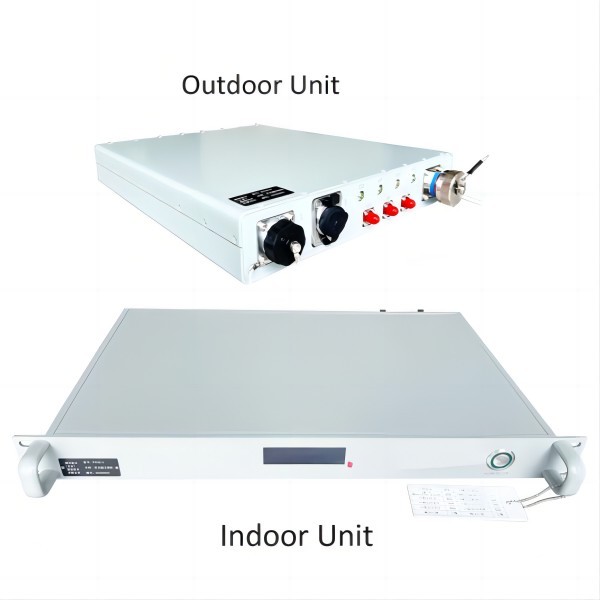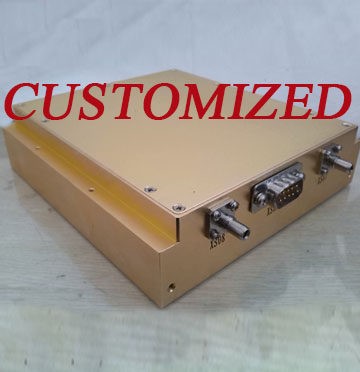

High-Precision Optical Delay Lines & RF Delay Lines: NEON Microwave Photonics
Because high-frequency communication and sensing systems are changing so quickly, signal processing needs to change too. Microwave photonics (MWP) is a new field that combines radio frequency (RF) delay lines and optical delay lines (ODL) to overcome the physical limits of traditional electronic components in terms of bandwidth and signal integrity. This article looks at how these technologies work, what they can be used for, and what the current market trends are. It focuses on their use in 5G-Advanced, radar systems, and aerospace engineering.
Fundamental Principles and Physical Mechanisms
1. Radio Frequency (RF) Delay Lines
An RF delay line is an electronic component designed to introduce a specific time displacement to an electromagnetic signal. In conventional engineering, this is achieved through three primary methods:
- Coaxial Cable Delay: It is a function of the physical length of the transmission line. On the other hand, dependable but encounters pronounced signal loss at frequencies above 10 GHz and is bulky in design.
- Surface Acoustic Wave (SAW) Delay: Piezoelectric substrate takes electronic signals and turns them into acoustic signals. Due to their compact form, these are limited by production to bands far below 3 GHz legal boundaries.
- Digital Delay: Comprises digitizing, saving to memory, and transmitting back to analog. Such a procedure brings about mistakes in the process of quantization and a certain delay in data processing, which prohibits the use of this in high-speed analog applications for real-time.
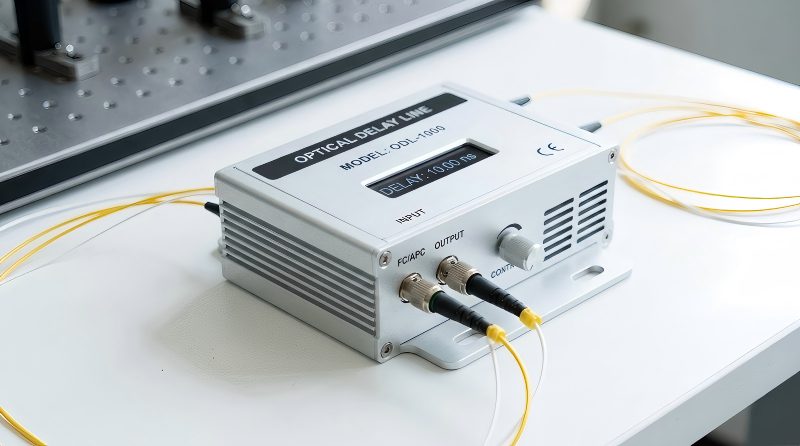
2. Optical Delay Lines (ODL)
By directing the RF signal to an optical carrier, the optical delay lines alter the signal transmission. Such a transmitted RF signal first follows the optical path (optical fiber, or free-space) and is reconverted in the RF domain at the end.
- Low Attenuation: Optical fibers exhibit a loss of approximately 0.2 dB/km at the 1550 nm wavelength, which is independent of the modulated RF frequency.
- Ultra-Wide Bandwidth: ODLs can support instantaneous bandwidths ranging from DC to over 100 GHz without the dispersion issues common in copper-based systems.
Microwave Photonics: The Convergence of RF and Optics
The Microwave Photonics (MWP) technique is designed to assist in the handling of RF signals by integrating various optoelectronic solutions, which tackle traditional electronics problems with the aid of fast and low loss optical energy in relation to the electronic scale.
1. The Signal Transformation Chain
A standard microwave photonic link consists of three functional stages:
- Electrical-to-Optical (E/O) Modulation: The input RF signal drives either a Directly Modulated Laser (DML) or an external Mach-Zehnder Modulator (MZM).
- Optical Processing/Delay: The signal passes through fixed-length fibers, optical switch matrices (for programmable delay), or high-Q optical resonators.
- Optical-to-Electrical (O/E) Conversion: A high-speed Photodetector (PD) recovers the RF envelope, maintaining the timing delay introduced in the optical domain.
2. Key Performance Indicators (KPIs)
To ensure industrial reliability, MWP systems must meet stringent criteria:
- Delay Accuracy and Resolution: Systems like those developed by NEON provide delay accuracies within ±0.5% or better, with resolutions reaching the picosecond level.
- Amplitude Flatness: Maintaining a consistent gain across the entire frequency spectrum (e.g., ±1 dB variation from 1 GHz to 18 GHz) is vital for signal fidelity.
- Phase Stability: The system must resist phase drifts caused by thermal expansion, often requiring active temperature compensation modules.

Industrial Applications and Strategic Use Cases
1. Radar Systems and True Time Delay (TTD)
With modern Phased Array Radars, beam-steering is typically carried out by the use of phase shifters. On the other hand, at broad bandwidths, the looking in different frequency directions of radar beam is also “Beam Squint”.
Optical Delay Lines provide True Time Delay (TTD). Because the delay is a function of time rather than phase, the beam direction remains constant across the entire frequency range. This is essential for high-resolution imaging radars and electronic warfare (EW) systems.
2. Aerospace and Satellite Communications
The aerospace industry prioritizes SWaP (Size, Weight, and Power).
- Weight Reduction: One kilometer of optical fiber weighs a fraction of an equivalent coaxial cable. For satellite payloads, this translates directly into reduced launch costs.
- EMI Immunity: Fiber optics are dielectric and immune to Electromagnetic Interference (EMI) and Lightning Electromagnetic Pulses (LEMP). This ensures secure signal transmission in the electrically noisy environments of aircraft and spacecraft.
3. 5G-Advanced and 6G Research
As the industry moves toward 6G and the use of Terahertz (THz) frequencies, ODLs are used in testbeds to simulate multi-path fading and signal propagation delays. They provide the necessary precision to synchronize time-sensitive networking (TSN) protocols in next-generation base stations.
2025-2026 Technological Hotspots and Market Trends
1. Silicon Photonics (Si-Ph) Integration
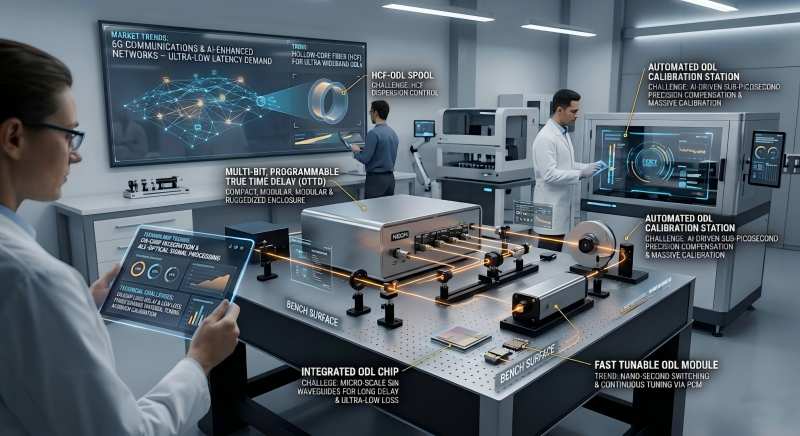
The transition from discrete fiber spools to on-chip optical delay lines is a major research focus. By etching nano-photonic waveguides onto silicon substrates, engineers can create compact delay structures. While silicon-based delays are currently limited in total delay length compared to fiber, they are ideal for short-range synchronization in high-performance computing (HPC) and LiDAR sensors.
2. Automated Testing and Simulation
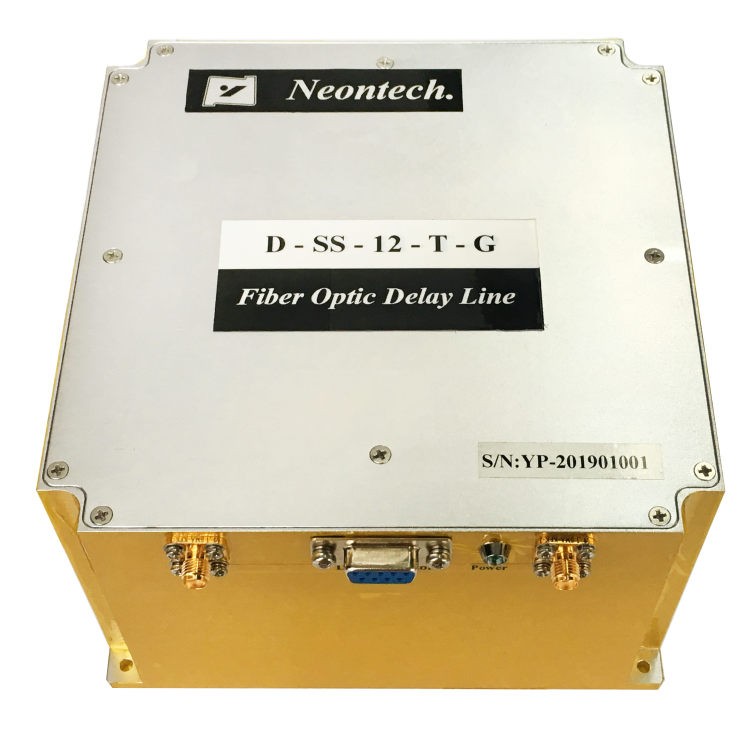
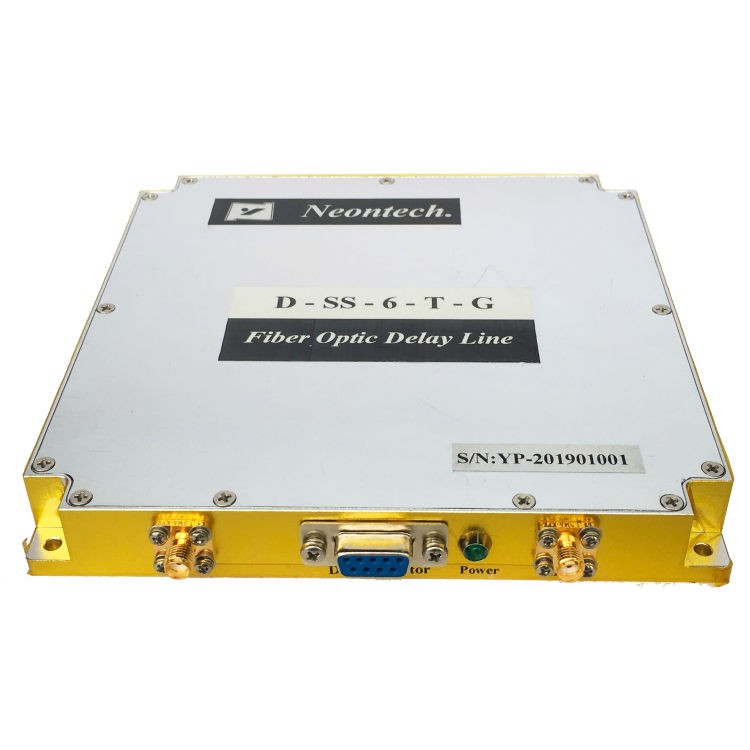
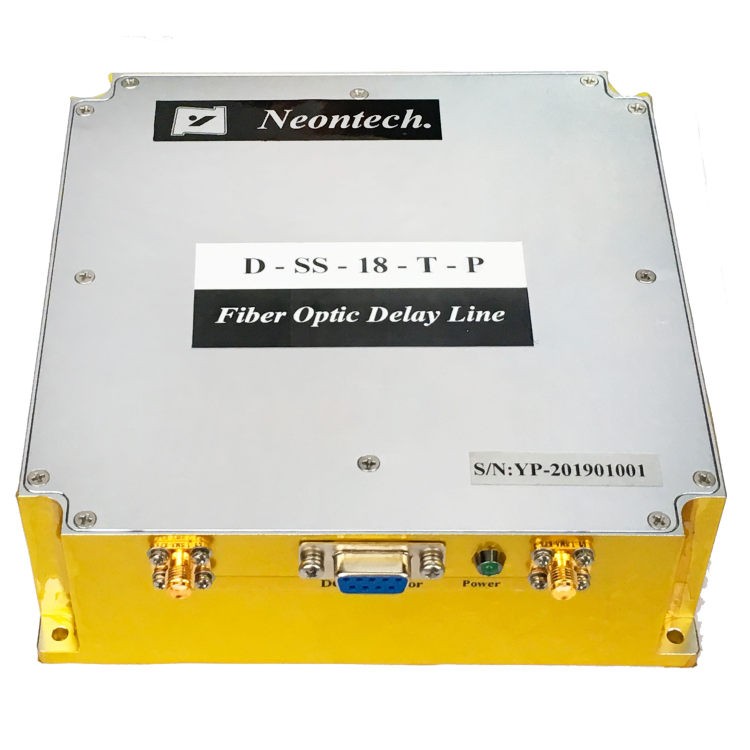
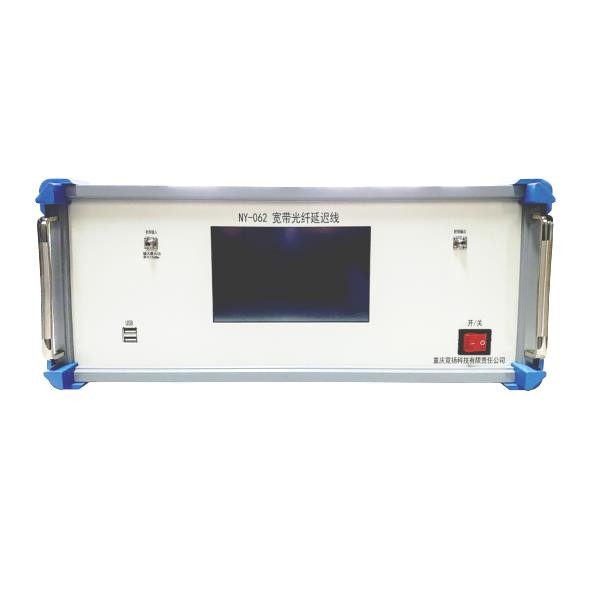
The demand for “Hardware-in-the-Loop” (HiL) simulation is growing. Companies are integrating ODLs into automated rack-mounted systems that can simulate complex electromagnetic battlefields or satellite-to-ground communication links in real-time. NEON’s high-frequency optical delay modules (supporting up to 18 GHz and 40 GHz) are representative of this trend toward high-frequency, high-integration commercial solutions.
3. Quantum Signal Synchronization
Quantum key distribution (QKD) and distributed quantum computing require sub-picosecond timing to maintain qubit coherence. Specialized optical delay lines with ultra-low jitter are becoming standard equipment in quantum optics laboratories worldwide.
The integration of RF and optical delay line technologies represents a fundamental shift in high-frequency signal processing. Microwave photonics has solved the historical trade-offs between distance, frequency, and weight, providing a scalable solution for the next generation of radar and communication infrastructure. Over the next five years, the focus of the industry will remain on increasing the level of integration, enhancing automated tuning speeds, and ensuring the reliability of these systems in harsh operational environments. As the demand for bandwidth continues to rise, the “Optical Domain” will likely become the standard medium for all high-precision RF timing applications.