
How to Choose the Right Photodetector Bandwidth: 8 GHz, 12 GHz, 18 GHz, or 30 GHz
In the design of high-speed optical communication links, in the setup of test benches or in the development of microwave photonics systems, engineers often fall into a common psychological trap: that higher bandwidth is always better. From compact 8GHz photodetectors to ultra-wideband 30GHz photodetectors, it is tempting to specify the maximum available bandwidth such that the system is “future proof” for any conceivable signal rate or pulse requirement.
But in high speed optoelectronic design, blind maximisation of the bandwidth can lead to counterproductive engineering results. Selecting a bandwidth that is too wide adds unnecessary costs to the system, decreases the responsivity of the detectors, increases thermal and shot noise, and complicates overall system integration due to the strict impedance matching and RF connector requirements. For the architecture of your optical receiver to be optimised, you have to balance a number of interdependent parameters. These include the signal data rate, rise time, pulse width, the specific application requirements, measurement accuracy, and budget limitations. This guide provides a rigorous framework to help R&D engineers and procurement specialists determine the most suitable bandwidth for their exact operational needs.
Why Bandwidth Matters in High-Speed Photodetectors
To understand why bandwidth selection is critical, we must first examine the fundamental physics governing high-speed optoelectronic conversion. The electrical bandwidth of a photodetector defines the maximum frequency at which the device can convert modulated optical power into a faithful electrical RF output signal without significant attenuation or phase distortion. Formally defined as the -3dB frequency point, bandwidth dictates how sharply a photodetector responds to high-frequency modulation components.
When an optical signal impinges on the photodiode’s active area, electron-hole pairs are generated and swept across the depletion region by an internal electric field. The finite transit time of carriers across this depletion region, combined with the RC time constant formed by the photodiode junction capacitance and load resistance, establishes the frequency response. Insufficient bandwidth acts as a low-pass filter, rounding off sharp rising edges, broadening optical pulses, closing eye diagrams in digital communications, and causing severe Inter-Symbol Interference (ISI). Conversely, excessive bandwidth widens the noise equivalent bandwidth (NEB), admitting extraneous thermal and shot noise into the receiver chain while sacrificing responsivity.
Understanding the Relationship Between Data Rate and Bandwidth
The choice of photodetector bandwidth is fundamentally anchored in the modulation format and data rate of the optical signal. Different modulation schemes—such as Non-Return-to-Zero (NRZ), Pulse Amplitude Modulation 4-level (PAM4), and coherent optical formats—place distinct demands on the frequency response of the optical receiver.
A general rule of thumb for standard digital communication systems is that the photodetector and receiver bandwidth should be approximately 0.6 to 0.7 times the baud rate for NRZ signals, ensuring sufficient harmonic preservation while limiting noise bandwidth. Wider high bandwidth photodetectors are needed for advanced optical testing and microwave photonics to capture the high-frequency RF carrier harmonics and ultrafast optical pulses.
| Signal Type | Typical Data Rate / Standard | Recommended Detector Bandwidth |
| 10G Ethernet | 10 Gbps (NRZ) | 8 GHz |
| 25G Ethernet | 25 Gbps (NRZ / PAM4) | 12 GHz |
| 40G Communication | 40 Gbps Systems | 18 GHz |
| 100G Optical Testing | 100 Gbps / Multi-lane | 30 GHz |
| Microwave Photonics | Wideband RF over Fiber | 30GHz |
8GHz Photodetectors: Best for Cost-Effective High-Speed Testing
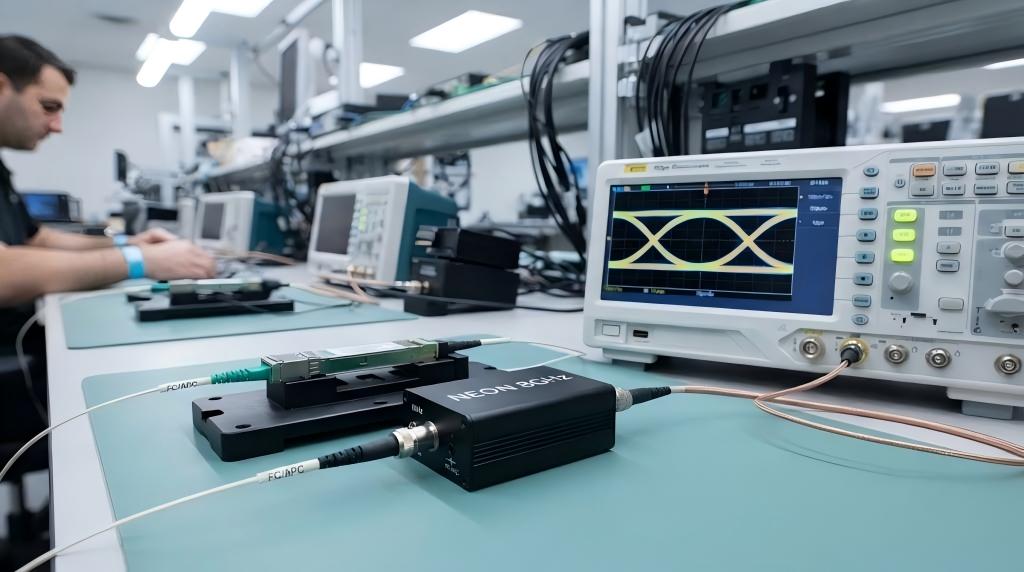
An 8GHz photodetector represents the workhorse solution for conventional high-speed optical laboratories, educational institutions, and 10G telecommunication testing environments. Designed to provide robust performance without unwarranted complexity, an 8GHz model strikes an optimal balance for mid-tier optical measurements.
Suitable Applications
- 10G optical communication transmission testing and transceiver manufacturing.
- General-purpose optical lab testing and optical-to-electrical conversion.
- Educational laboratories and university research setups.
- Basic monitoring of modulated laser diodes and fiber optic links.
Advantages & Limitations
The primary advantages of an 8GHz receiver include lower acquisition cost, higher responsivity due to a larger optimal absorption volume, better Signal-to-Noise Ratio (SNR), and easier physical integration. However, its limitations become apparent when dealing with ultrafast phenomena: an 8GHz unit cannot accurately capture very short optical pulses and lacks the frequency headroom required for advanced 25G or 40G communication standards.
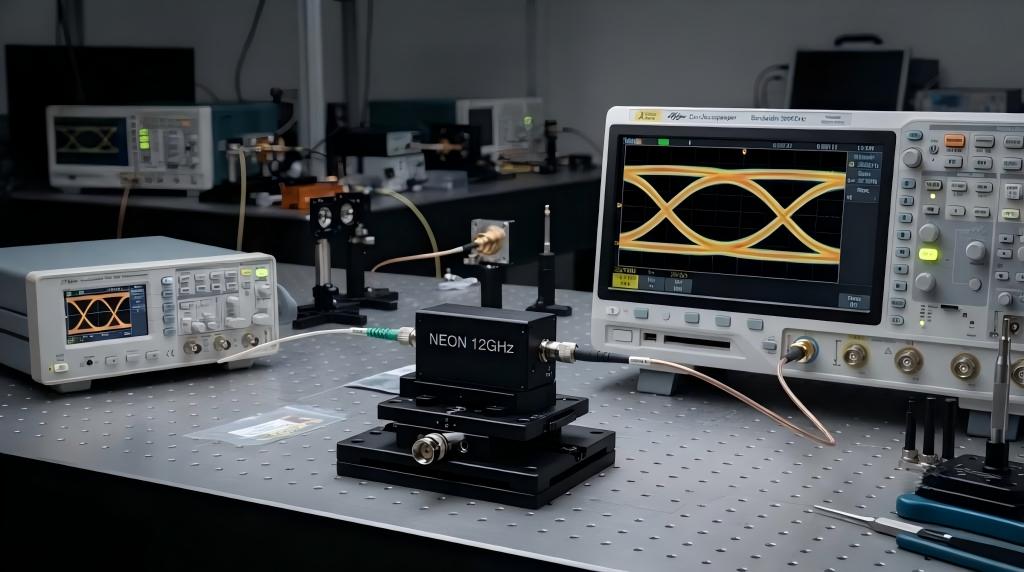
When Should You Choose a 12GHz Photodetector?
Stepping up to a 12GHz photodetector bridges the gap between standard 10G networks and high-performance 25G infrastructure. It is engineered specifically to support modern 25G Ethernet standards and high-speed fiber optic component manufacturing.
Typical Applications
- 25G Ethernet transmitter and receiver compliance testing.
- High-speed fiber optic component testing and passive optical network (PON) analysis.
- Optical module characterization in production lines and manufacturing QC.
Advantages
A 12GHz unit delivers balanced performance across wide operating wavelengths, offering a moderate cost profile while providing the improved rise time necessary to resolve 25G NRZ eye diagrams and multi-level signaling metrics accurately.
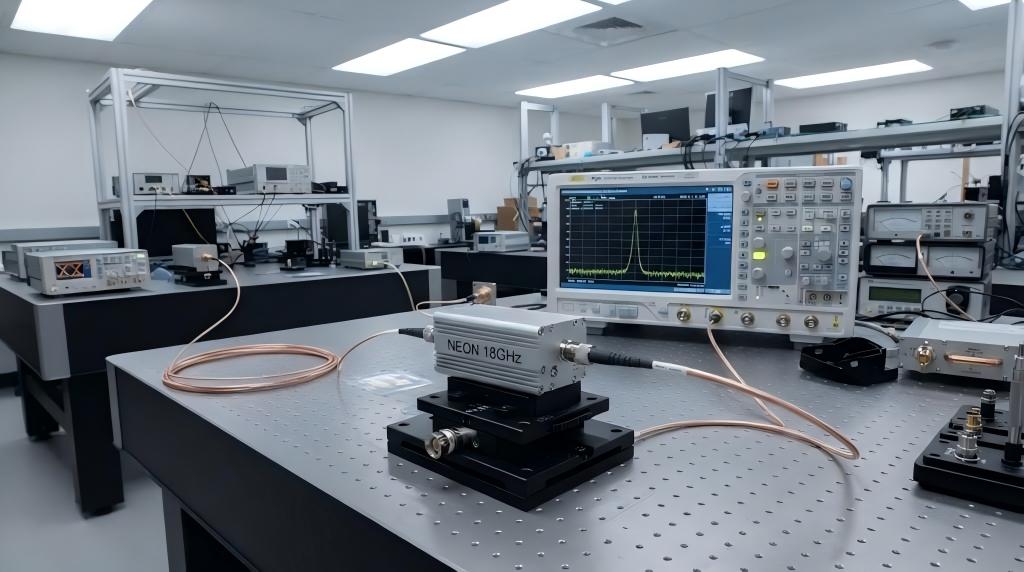
Why Engineers Choose 18GHz Photodetectors
When system requirements extend into 40G telecommunications, advanced pulse laser characterization, and high-frequency RF-over-Fiber (RoF) links, an 18GHz photodetector becomes essential.
Applications & Advantages
Engineers select 18GHz solutions for 40G communication systems, precision optical pulse characterization, high-speed academic and industrial research, and broadband analog RF photonic links. The principal advantage of an 18GHz detector is its superior pulse fidelity and wider frequency response, allowing engineers to examine higher-order harmonics without premature signal roll-off.
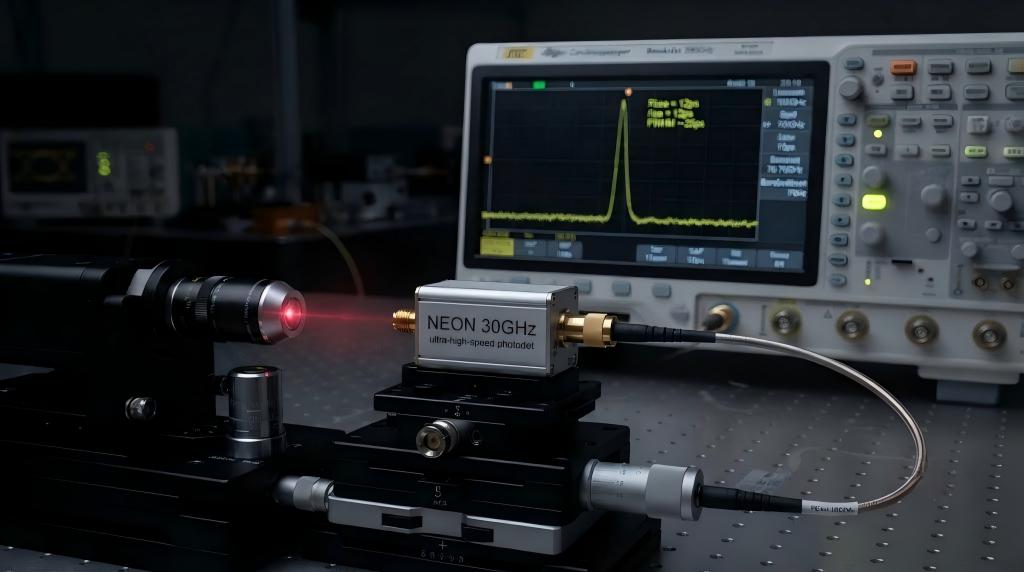
When Do You Really Need a 30GHz Photodetector?
At the pinnacle of high-speed optoelectronic testing sits the 30GHz photodetector. Offering exceptional bandwidth capabilities, a 30GHz device is designed for cutting-edge applications where signal integrity at extreme frequencies is non-negotiable.
Applications
- 100G/200G optical communication research and multi-lane validation.
- Coherent optical transmission systems and advanced modulation analysis.
- Microwave photonics and millimeter-wave RF signal generation and conversion.
- LiDAR research requiring extreme temporal resolution.
- Ultra-short pulsed laser measurements (sub-30 picosecond pulse widths).
Despite its outstanding performance, engineers must recognize that a 30GHz detector is largely unnecessary—and economically inefficient—for conventional 10G or 25G systems.
Rise Time vs Bandwidth
A fundamental mathematical relationship governs the time-domain and frequency-domain behavior of high-speed photodetectors. The system rise time (tr) is inversely proportional to the electrical bandwidth (BW), approximated by the well-known formula:
tr ≈ 0.35 / BW
| Bandwidth (BW) | Approximate Rise Time (tr) | Minimum Resolvable Pulse Width |
| 8 GHz | 44 ps | ~90 ps |
| 12 GHz | 29 ps | ~60 ps |
| 18 GHz | 19 ps | ~40 ps |
| 30 GHz | 12 ps | ~25 ps |
Understanding this relationship is vital when measuring fast optical pulses. If your laser source emits 20 ps pulses, using an 8GHz detector (with a 44 ps rise time) will severely distort the waveform, artificially broadening the pulse due to the detector’s sluggish temporal response.
Bandwidth vs Responsivity: Understanding the Trade-Off
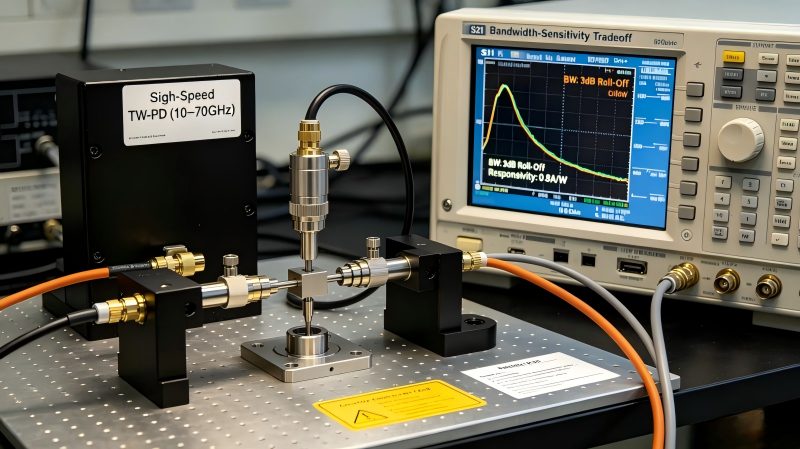
Optoelectronic design involves strict physical trade-offs. To achieve wider electrical bandwidth, photodiode manufacturers must reduce the active area diameter and decrease the depletion region thickness (or employ specialized bias and waveguide structures). This physical optimization introduces a direct trade-off between bandwidth and responsivity.
| Parameter | Lower Bandwidth (e.g., 8GHz) | Higher Bandwidth (e.g., 30GHz) |
| Responsivity (A/W) | Higher (larger absorption volume) | Lower (thinner absorption layer) |
| Noise Performance | Lower noise equivalent power | Higher integrated noise floor |
| Device Cost | Lower manufacturing complexity | Higher fabrication precision |
| Pulse Resolution | Lower temporal fidelity | Higher temporal resolution |
Engineering Takeaway: Pushing for maximum bandwidth inherently sacrifices raw sensitivity and increases noise. Always select the lowest bandwidth that fully satisfies your signal integrity requirements.
How to Select the Right Bandwidth for Your Application
To streamline procurement and design, follow this five-step practical decision guide:
Step 1. Determine your signal frequency: Identify the highest significant modulation frequency or RF carrier in your system.
Step 2. Estimate pulse width: Calculate the minimum optical pulse width you need to resolve without temporal distortion.
Step 3. Identify communication standard: Match your data rate (10G, 25G, 40G, 100G) against standard telecom/datacom specifications.
Step 4. Leave sufficient measurement margin: Apply a 20% to 30% margin above your maximum operating frequency to prevent attenuation at the -3dB knee.
Step 5. Avoid excessive bandwidth: Do not over-specify; stopping at the right bandwidth preserves your SNR and budget.
Common Mistakes When Selecting Bandwidth
Engineers frequently encounter pitfalls during the detector selection process. Avoiding these common errors ensures optimal system performance:
- Choosing the highest bandwidth without need: Leads to degraded SNR and inflated project costs.
- Ignoring oscilloscope limitations: Pairing a 30GHz photodetector with a 4GHz real-time oscilloscope wastes system capability.
- Overlooking RF connector frequency ratings: Using SMA cables/connectors for 30GHz signals instead of precision 2.4mm or 1.85mm connectors introduces massive signal reflection.
- Ignoring amplifier bandwidth: The net system bandwidth is limited by both the photodiode and the transimpedance amplifier (TIA).
- Confusing sampling rate with detector bandwidth: Digital sampling capability cannot recover optical information lost to a slow photodetector front-end.
- Neglecting cable losses: High-frequency RF cables suffer significant attenuation at 18GHz and 30GHz.
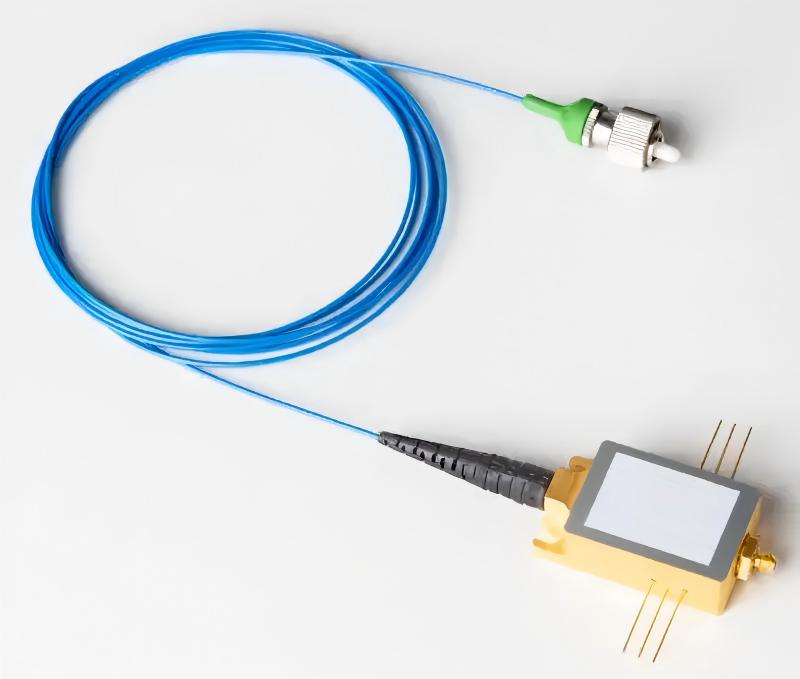
NEON High-Speed Photodetector Solutions
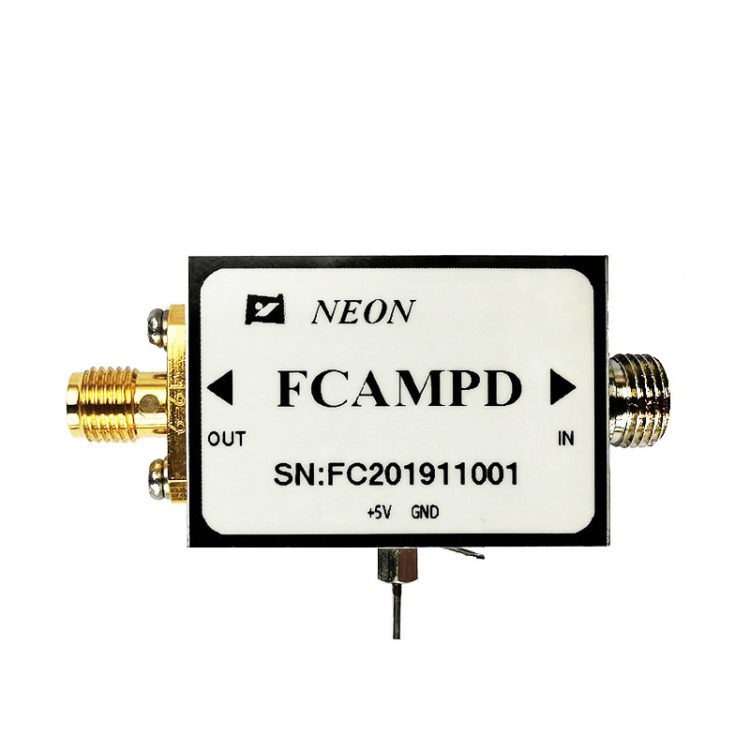
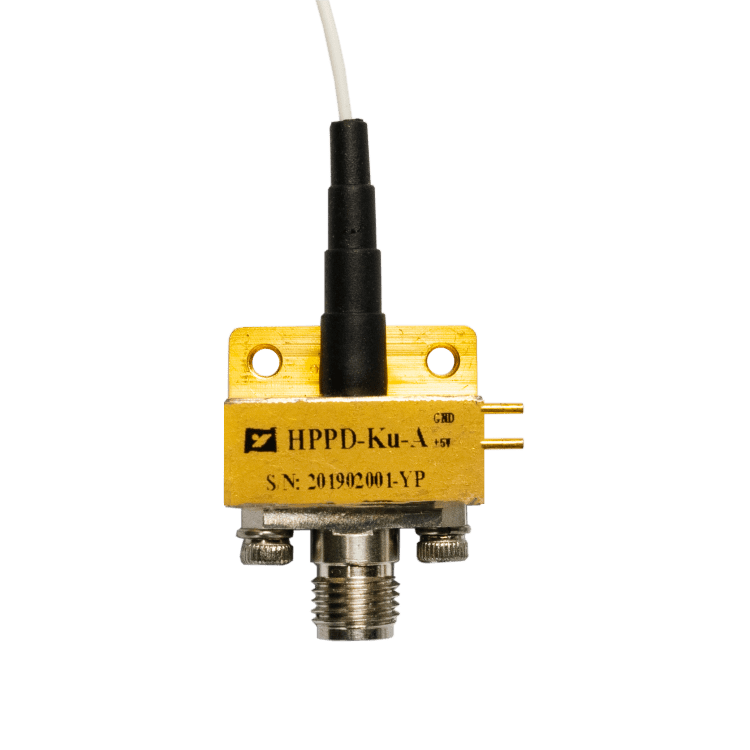
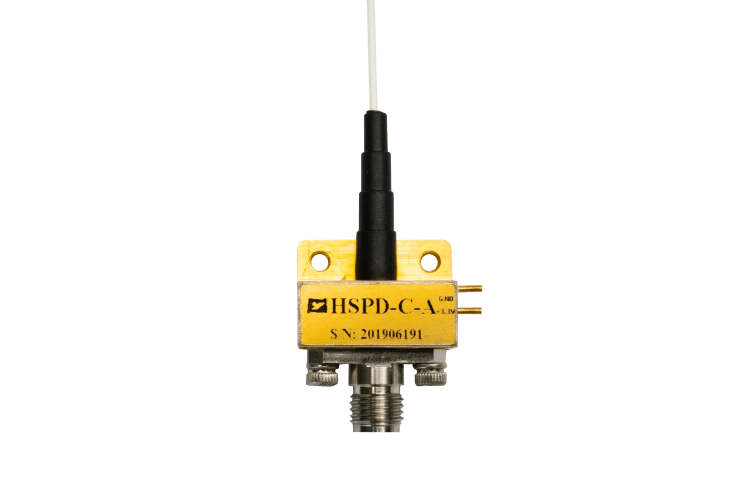
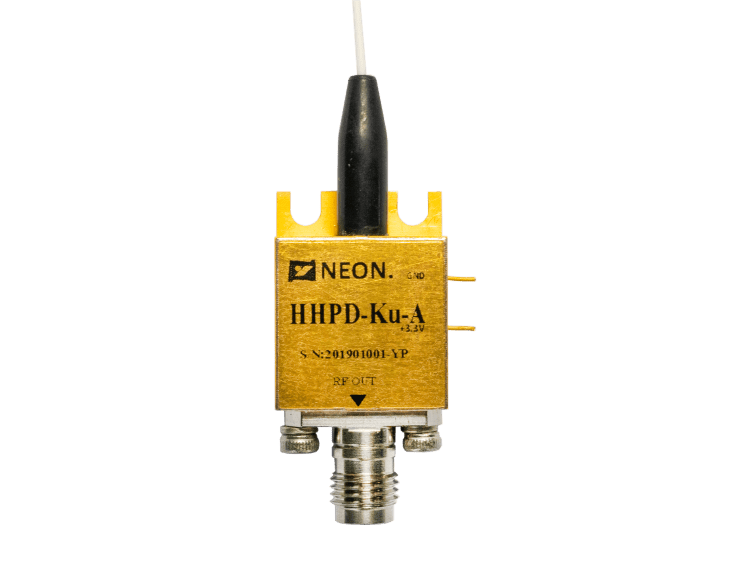
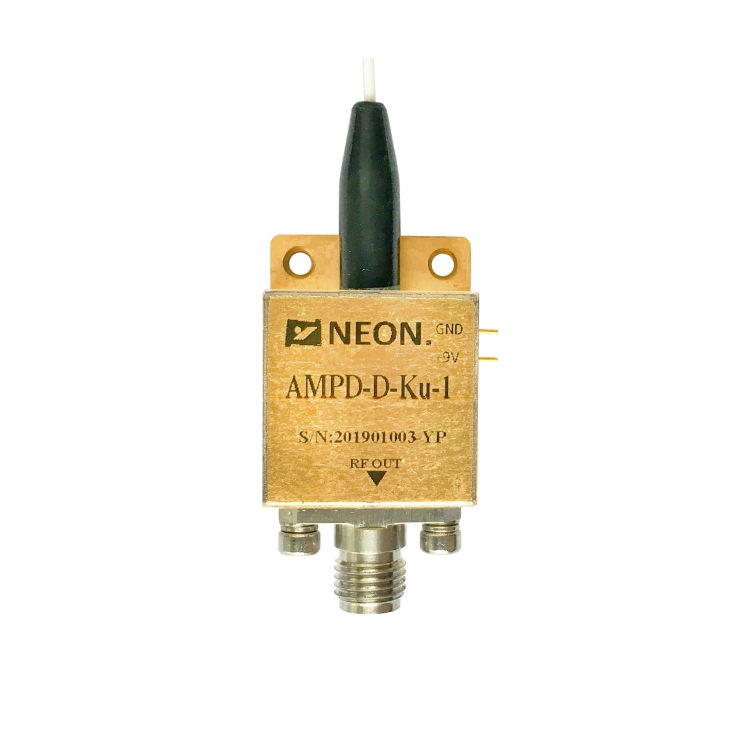
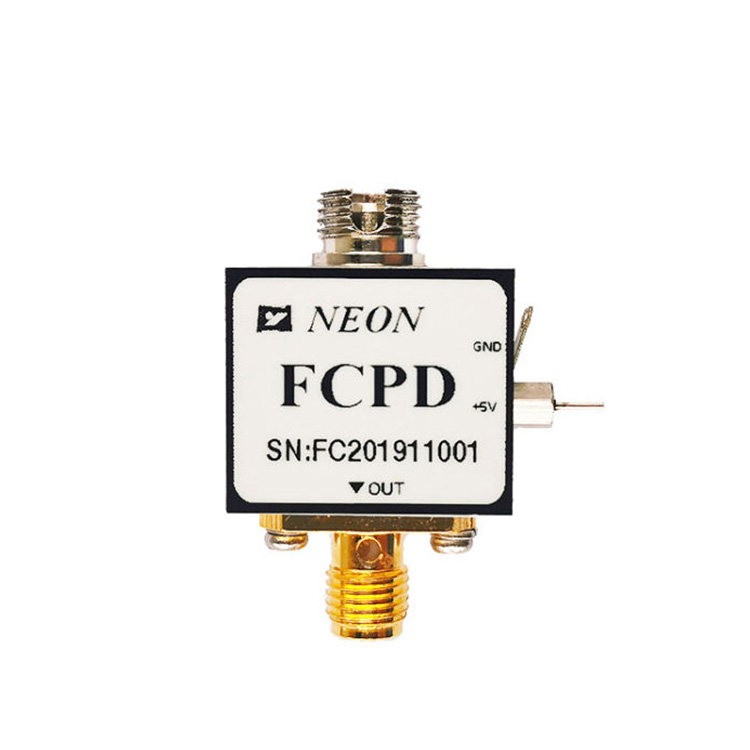
NEON’s portfolio of high-performance photodetectors is complete and engineered to satisfy the most demanding industrial and research requirements. Our modules use the latest InGaAs detector technology and operate in the critical wavelength range of 1250-1650 nm, ensuring high reliability for telecommunications and sensing applications.
Portfolio Highlights
- 8GHz Series: Ideal for 10G systems, educational labs, and cost-sensitive projects requiring high responsivity and robust SNR.
- 12GHz Series: Engineered for 25G communication, optical module manufacturing, and rigorous fiber optic quality control.
- 18GHz Series: Tailored for research laboratories, RF photonics, and precision pulse characterization.
- 30GHz Series: Built for coherent communication, advanced optical testing, microwave photonics, and next-generation optical networks.
Core product strengths across the NEON portfolio include high responsivity, low dark current, wide dynamic range, versatile fiber-coupled configurations (FC/APC, FC/PC), robust RF output options (SMA / 2.4mm), and compact, EMI-shielded packaging.
Frequently Asked Questions
Is higher bandwidth always better?
No. Higher bandwidth reduces responsivity, increases noise, raises system cost, and makes RF integration more difficult. You should choose the bandwidth that precisely matches your application requirements.
How much bandwidth do I need for 25G optical communication?
A 12GHz photodetector is typically recommended for 25G NRZ and PAM4 testing, providing an optimal balance of frequency response and signal fidelity.
Can an 8GHz detector measure a 10Gbps signal?
Yes. An 8GHz detector provides ideal frequency headroom and high responsivity for standard 10G Ethernet and telecom applications.
What bandwidth is recommended for pulse laser measurement?
It depends on your pulse width. To resolve a 20 ps optical pulse accurately, an 18GHz or 30GHz detector is required to ensure the rise time is fast enough.
Does bandwidth affect responsivity?
Yes. Wider bandwidths require thinner absorption regions and smaller active areas, which inherently reduce the device’s responsivity (A/W).
Does a 30GHz detector produce more noise?
Yes. A wider electrical bandwidth integrates more thermal and shot noise across the frequency spectrum, resulting in a higher noise floor compared to lower-bandwidth detectors.
How do I match detector bandwidth with my oscilloscope?
Your oscilloscope’s analog bandwidth should match or slightly exceed the photodetector’s bandwidth to prevent measurement bottlenecks.
Can one detector support multiple applications?
Yes, if your primary application requires high-frequency measurements, an 18GHz or 30GHz detector can be used for lower-speed signals, provided you account for the lower responsivity.