

Photodetector Responsivity vs Sensitivity: What Is the Difference?
When comparing photodetectors, responsivity and sensitivity are often treated as if they describe the same performance characteristic. They do not. Photodetector responsivity measures how efficiently a detector converts incident optical power into electrical current, while photodetector sensitivity describes how weak an optical signal can be reliably detected under defined operating conditions. A detector with higher responsivity can generate a stronger electrical signal, but this does not automatically mean better sensitivity because noise, bandwidth, dark current, and receiver conditions also affect detection performance. Understanding the difference between photodetector responsivity and sensitivity is therefore essential when selecting a detector for high-speed optical communication, microwave photonics, RF-over-fiber, and optical measurement applications.
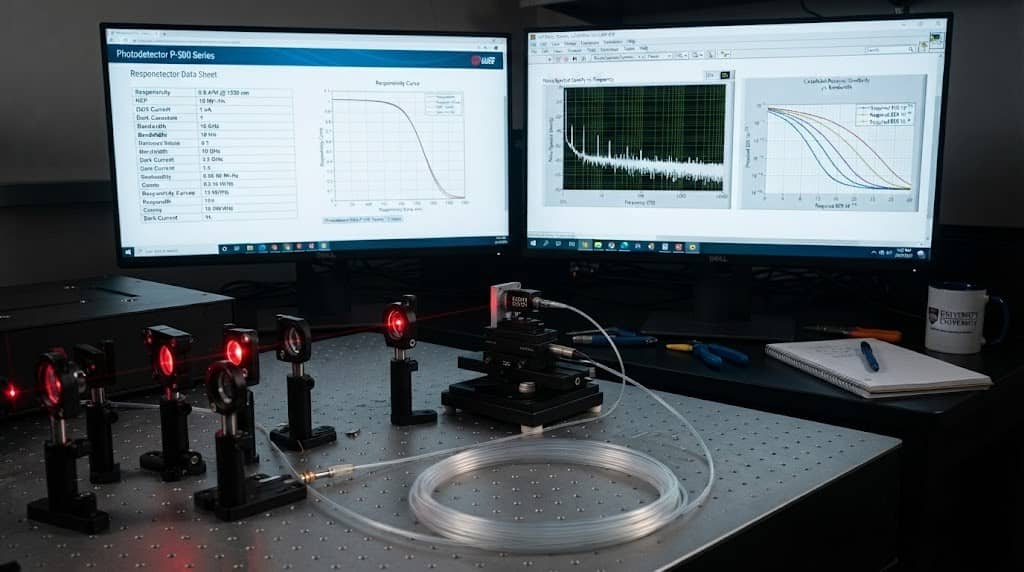
Photodetector Responsivity vs Sensitivity: The Key Difference
The easiest way to distinguish the two parameters is to consider the question each one answers.
- Responsivity answers: How much electrical output does the photodetector produce for a given optical input?
- Sensitivity answers: How weak an optical signal can the detector or receiver reliably detect?
Therefore, responsivity is primarily a signal conversion parameter, while sensitivity is a signal detection parameter.
| Parameter | Photodetector Responsivity | Photodetector Sensitivity |
| What it measures | Optical-to-electrical conversion | Weak-signal detection capability |
| Typical unit | A/W | W, dBm, or application-specific units |
| Main concern | Generated photocurrent | Minimum detectable signal |
| Noise directly represented? | No | Yes, depending on definition |
| Wavelength dependent? | Yes | Yes |
| Bandwidth dependent? | Not inherently | Often relevant |
| Main use | Device characterization | Device/receiver performance evaluation |
In simple terms: responsivity tells you how much signal the detector generates; sensitivity tells you how weak a signal it can detect. This distinction is the foundation for correctly interpreting a photodetector datasheet.
What Is Photodetector Responsivity?
Photodetector responsivity describes the relationship between incident optical power and generated photocurrent. It is normally expressed in amperes per watt (A/W).
The basic equation is:
R = Iph / Pin
where:
- R is responsivity in A/W
- Iph is photocurrent
- Pin is incident optical power
For a detailed explanation of test equipment, measurement conditions, and calculation methods, see our guide on how to measure photodetector responsivity.
For example, a photodetector with a responsivity of 0.8 A/W receiving 1 mW of optical power would ideally generate approximately 0.8 mA of photocurrent. A higher responsivity therefore means that the detector produces more electrical current from the same optical input.
However, responsivity does not by itself tell you how easily a weak signal can be distinguished from noise. This is an important distinction when comparing high-speed photodetectors.
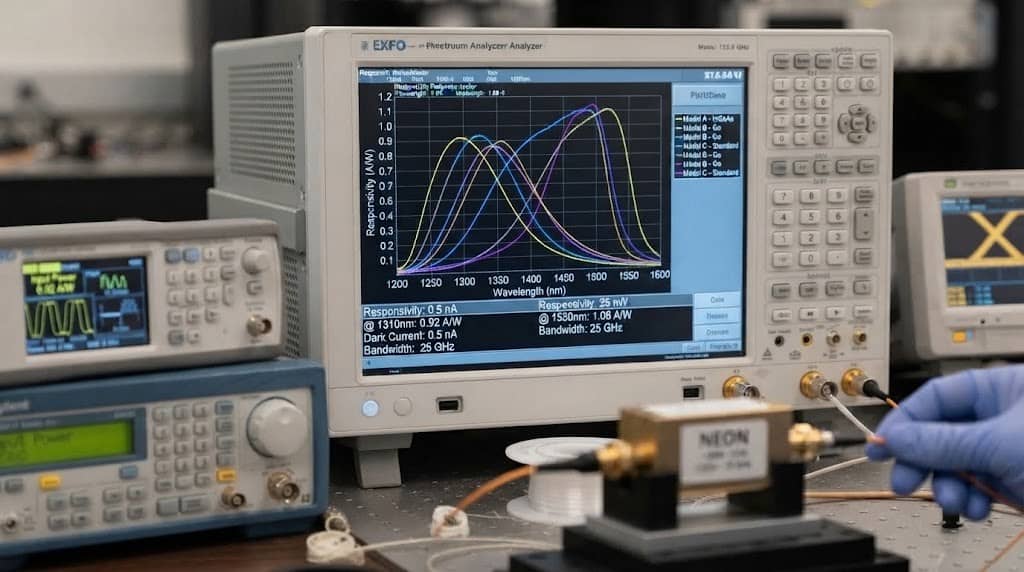
Responsivity Is Wavelength Dependent
Responsivity is not necessarily constant across the detector’s operating spectrum. A photodetector may have different responsivity values at:
- 850 nm
- 1310 nm
- 1550 nm
Therefore, when comparing detector responsivity, the value must be considered at the actual operating wavelength. A datasheet specification such as “0.9 A/W” is more meaningful when accompanied by information about wavelength, bias voltage, temperature, and measurement conditions.
What Is Photodetector Sensitivity?
Photodetector sensitivity describes the ability to detect a low-level optical signal under specified conditions. Unlike responsivity, sensitivity is closely related to the minimum signal that can be distinguished from the noise floor.
Depending on the application, sensitivity may be defined using:
- Minimum detectable optical power
- Signal-to-noise ratio (SNR)
- Bit error rate (BER)
- Noise-equivalent power (NEP)
- Receiver sensitivity
- A specified electrical bandwidth
This means that the exact meaning of “sensitivity” should always be checked in the relevant datasheet or test specification. For example, sensitivity specified at a narrow bandwidth cannot necessarily be compared directly with sensitivity measured over a much wider bandwidth.
Sensitivity Is a System-Relevant Performance Metric
Responsivity can often be treated as a relatively direct detector characteristic. Sensitivity, however, can depend on the broader measurement or receiver configuration.
Factors may include:
- Detector noise
- Dark current
- Amplifier noise
- Electrical bandwidth
- Temperature
- Load impedance
- Signal format
- Required SNR or BER
Consequently, sensitivity is often more useful than responsivity when the primary engineering question is: Can this detector reliably detect the optical signal available in my system?
Why Higher Responsivity Does Not Always Mean Higher Sensitivity
One of the most important points in photodetector selection is that a higher responsivity value does not automatically indicate better sensitivity.
Consider two hypothetical detectors:
| Parameter | Detector A | Detector B |
| Responsivity | 0.85 A/W | 1.00 A/W |
| Bandwidth | 20 GHz | 30 GHz |
| Noise floor | Lower | Higher |
| Dark current | Lower | Higher |
| Photocurrent at same input | Lower | Higher |
| Overall weak-signal performance | Potentially better | Not necessarily better |
Detector B generates more photocurrent from the same optical input because its responsivity is higher. However, if Detector B also has a significantly higher noise floor, the stronger electrical signal does not necessarily translate into a better detection limit.
This leads to an important engineering rule: Higher responsivity can improve signal generation, but it does not guarantee better sensitivity.
Responsivity Determines the Strength of the Electrical Signal
For a fixed optical input: Higher responsivity → higher photocurrent
This can provide more signal to downstream electronics and may improve available signal margin.
For example, if 100 μW of optical power is incident on two detectors:
- Detector A: 0.7 A/W → approximately 70 μA photocurrent
- Detector B: 1.0 A/W → approximately 100 μA photocurrent
Detector B therefore generates a larger electrical signal. But this comparison only describes the signal component. It does not establish which detector provides the better minimum detectable signal.
Noise Determines How Clearly the Signal Can Be Detected
The useful engineering comparison is therefore not simply: Which detector has the highest responsivity?
Instead, ask: Which detector generates sufficient electrical signal while maintaining an acceptable noise level over the required bandwidth?
This distinction is particularly important for microwave photonics, RF links, optical receivers, and precision optical measurement.
How Responsivity Affects Photodetector Sensitivity
Although responsivity and sensitivity are different, they are still related.
1. Higher Responsivity Can Improve Signal Margin
When optical input remains constant, increasing responsivity increases photocurrent. That can make the desired signal easier for subsequent electronics to process. However, the benefit depends on whether the detector’s noise performance remains suitable.
The practical relationship can therefore be viewed as Optical Power → Responsivity → Photocurrent → Signal-to-Noise Performance → Detectability rather than Higher Responsivity = Higher Sensitivity
2. Responsivity Must Be Evaluated With Noise
For weak optical signals, a detector with moderate responsivity and low noise can potentially outperform a detector with higher responsivity but substantially greater noise. This is why photodetector responsivity should be evaluated together with:
- Noise
- NEP
- Dark current
- Bandwidth
- SNR
- Required detection threshold
The appropriate balance depends on the application rather than on a single specification.
How to Compare Responsivity and Sensitivity in a Photodetector Datasheet
Datasheets can contain several similar-looking specifications, so understanding how to interpret them is critical.
1. How to Read Responsivity Specifications
Common specifications include:
- Responsivity: A/W
- Responsivity @ 1310 nm
- Responsivity @ 1550 nm
- Typical responsivity
- Minimum responsivity
- Spectral responsivity
When comparing products, verify that the responsivity values were measured at comparable:
- Wavelength
- Bias voltage
- Temperature
- Optical power
The value at the intended operating wavelength is normally the most relevant.
2. How to Read Sensitivity Specifications
Sensitivity specifications require additional caution. Check whether the value is associated with:
- Optical wavelength
- Electrical bandwidth
- SNR requirement
- BER requirement
- Measurement bandwidth
- Temperature
- Load
- Receiver configuration
A sensitivity number without test conditions can be difficult to interpret. For this reason, never compare photodetector sensitivity values without checking the conditions under which they were measured.
3. Why Datasheet Conditions Matter
Imagine two detectors with the following specifications:
- Detector A: sensitivity measured at 10 GHz bandwidth
- Detector B: sensitivity measured at 30 GHz bandwidth
These figures cannot automatically be treated as an equivalent comparison. A wider measurement bandwidth can change the noise contribution and therefore affect practical detection performance. For engineers and procurement teams, the measurement conditions are part of the specification.
Responsivity vs Sensitivity in Different Applications
The importance of each parameter changes according to the application.
1. High-Speed Optical Communication
For high-speed optical communication, both responsivity and sensitivity matter. However, they should be evaluated together with:
- Bandwidth
- Noise
- BER
- Saturation power
- Linearity
A detector with high responsivity but insufficient bandwidth may not support the required signal speed. Conversely, a detector with extremely high bandwidth but inadequate signal conversion may not provide sufficient electrical output.
The practical selection criteria are therefore Responsivity + bandwidth + noise + receiver performance rather than maximum responsivity alone.
For a more detailed approach to bandwidth selection, see our guide to photodetector bandwidth selection.
2. Microwave Photonics and RF-over-Fiber
In microwave photonics and RF-over-fiber systems, the photodetector converts an optical signal into an RF electrical signal. Responsivity directly affects the optical-to-electrical conversion process, while overall RF performance may also depend on:
- RF bandwidth
- Output power
- Linearity
- Noise
- Impedance matching
- Dynamic range
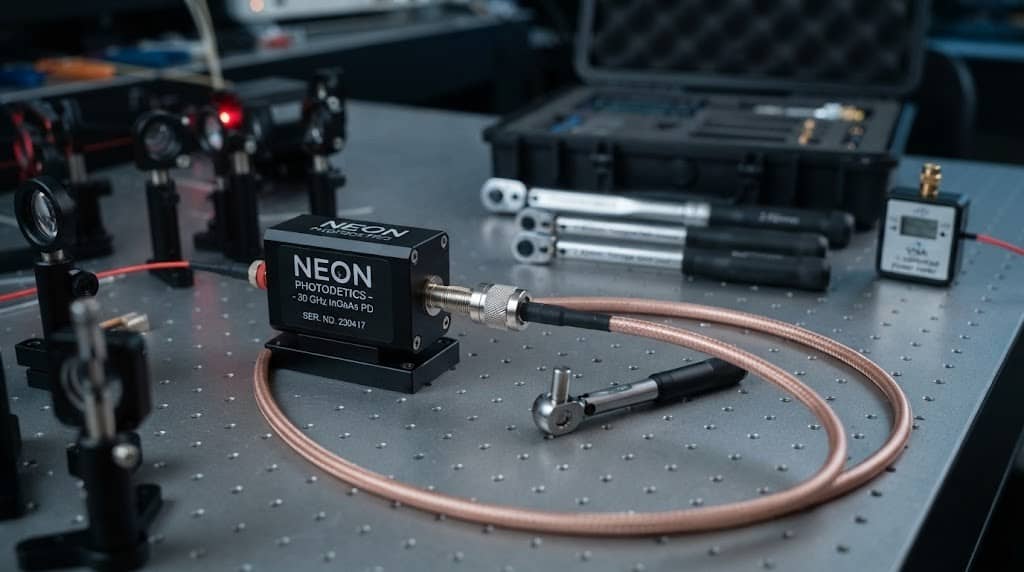
For these applications, a balanced combination of responsivity, bandwidth, linearity, and noise can be more valuable than the highest A/W rating. NEON’s high-speed InGaAs photodetector modules are designed for digital and analog applications, with bandwidth options from 8 GHz to 30 GHz depending on the model.
3. Low-Level Optical Detection
For low-light or weak-signal measurement, sensitivity becomes particularly important. Engineers may need to evaluate:
- Minimum detectable optical power
- NEP
- Noise
- Dark current
- Measurement bandwidth
Responsivity remains relevant because it determines the electrical signal generated from the incident optical power, but the final detection threshold depends on the relationship between signal and noise.
Which Parameter Should You Prioritize?
There is no universal answer to whether photodetector responsivity or sensitivity should receive greater priority. The correct choice depends on the system’s objective.
| Application | Responsivity Priority | Sensitivity Priority | Other Critical Parameters |
| High-speed optical communication | High | High | Bandwidth, BER, noise |
| Microwave photonics | High | High | Linearity, RF output |
| RF-over-fiber | High | High | Dynamic range, impedance |
| Weak optical signal detection | High | Very High | NEP, noise, dark current |
| Optical measurement | High | High | Wavelength response, stability |
| High-power optical detection | Medium | Medium | Saturation, linearity |
| Ultra-wideband detection | High | High | Bandwidth, frequency response |
For most high-speed systems, the best approach is to evaluate responsivity and sensitivity as part of a larger parameter set.
A Practical Photodetector Selection Workflow
A structured selection process helps prevent the common mistake of choosing a detector based only on its A/W specification.
Step 1: Define the Operating Wavelength
Identify the wavelength or wavelength range used by the system. Common optical communication wavelengths include 850 nm, 1310 nm, and 1550 nm. Then check the detector’s responsivity at the actual operating wavelength.
Step 2: Define the Optical Power Range
Determine:
- Minimum optical input
- Typical optical input
- Maximum optical input
This establishes whether the application prioritizes weak-signal detection, linearity, saturation performance, or a combination.
Step 3: Determine the Required Bandwidth
Define bandwidth based on the actual signal requirements. Consider:
- Modulation frequency
- Data rate
- RF frequency
- Signal rise time
- Required system margin
Do not automatically select the detector with the highest available bandwidth if the application does not require it.
Step 4: Compare Responsivity
Compare responsivity at equivalent conditions. Check:
- A/W value
- Operating wavelength
- Bias
- Temperature
- Spectral response
Step 5: Evaluate Noise and Sensitivity
Next, evaluate parameters associated with weak-signal detection:
- Noise
- NEP
- Dark current
- Sensitivity
- SNR
- BER
This step prevents responsivity from being incorrectly used as a substitute for sensitivity.
Step 6: Verify System Compatibility
Finally, evaluate the detector as part of the complete system. Important factors can include:
- 50 Ω impedance
- RF connector
- Bias requirements
- Packaging
- Temperature range
- Mechanical integration
- Electrical interface
The overall selection process can therefore be summarized as: Wavelength → Optical Power → Bandwidth → Responsivity → Noise → Sensitivity → System Compatibility. This approach provides a more reliable basis for selecting a high-speed photodetector than comparing one specification in isolation.
Common Mistakes When Comparing Responsivity and Sensitivity
Mistake 1: Treating Responsivity and Sensitivity as Synonyms
Responsivity measures optical-to-electrical conversion, while sensitivity concerns weak-signal detection. They are related but not interchangeable.
Mistake 2: Selecting the Highest A/W Value
A higher responsivity produces more photocurrent from a given optical input, but it does not automatically mean lower minimum detectable power. Noise and bandwidth must also be considered.
Mistake 3: Comparing Sensitivity Without Checking Test Conditions
Sensitivity values should be compared only when the relevant test conditions are sufficiently comparable. Check wavelength, bandwidth, SNR or BER requirements, temperature, and measurement configuration.
Mistake 4: Ignoring Bandwidth
Responsivity alone cannot determine whether a detector is suitable for a high-speed system. A detector must provide sufficient bandwidth for the required signal while maintaining appropriate noise and signal performance.
Mistake 5: Evaluating Only the Detector
The actual detection capability can depend on the complete signal chain: Photodetector + amplifier + load + bandwidth + signal-processing system. This is especially important in RF photonics, microwave photonics, and high-speed optical receivers.
Frequently Asked Questions
Q1: Is photodetector responsivity the same as sensitivity?
No. Photodetector responsivity measures the electrical output generated per unit of incident optical power, while sensitivity describes the minimum optical signal that can be reliably detected under defined conditions.
Q2: Does higher photodetector responsivity always mean better sensitivity?
No. Higher responsivity can produce a stronger electrical signal, but sensitivity is also affected by noise, bandwidth, dark current, and receiver conditions.
Q3: Why can two photodetectors with similar responsivity have different sensitivity?
Because responsivity mainly describes signal conversion. Two detectors can have similar A/W values but different noise floors, dark currents, bandwidths, or receiver configurations, resulting in different detection performance.
Q4: Should I compare responsivity or sensitivity when selecting a photodetector?
Both should be considered. Responsivity indicates how efficiently optical power is converted into an electrical signal, while sensitivity indicates weak-signal detection capability. For practical selection, compare both together with bandwidth, noise, wavelength, and system requirements.
Q5: How does bandwidth affect photodetector sensitivity?
Bandwidth affects the signal and noise included in the measurement. Therefore, sensitivity can vary with the required bandwidth even when the detector’s nominal responsivity remains unchanged. High-speed applications should evaluate bandwidth and sensitivity together.