

TFLN vs Silicon Photonics: Which Platform Is Better for High-Speed Optical Communication?
As optical communication moves toward higher baud rates and tighter power budgets, the choice of photonic platform is becoming more important. TFLN (thin-film lithium niobate) and silicon photonics are both strong candidates for high-speed optical systems, but they solve different engineering problems.
Silicon photonics is well established for compact, highly integrated optical circuits and high-volume manufacturing. TFLN, meanwhile, is particularly attractive when high-speed electro-optic modulation, low drive voltage and signal linearity are critical.
So which platform is better? There is no universal winner. The right choice depends on the required modulation performance, integration density, production scale and system architecture. For some next-generation designs, combining the strengths of both platforms may be more practical than choosing only one.
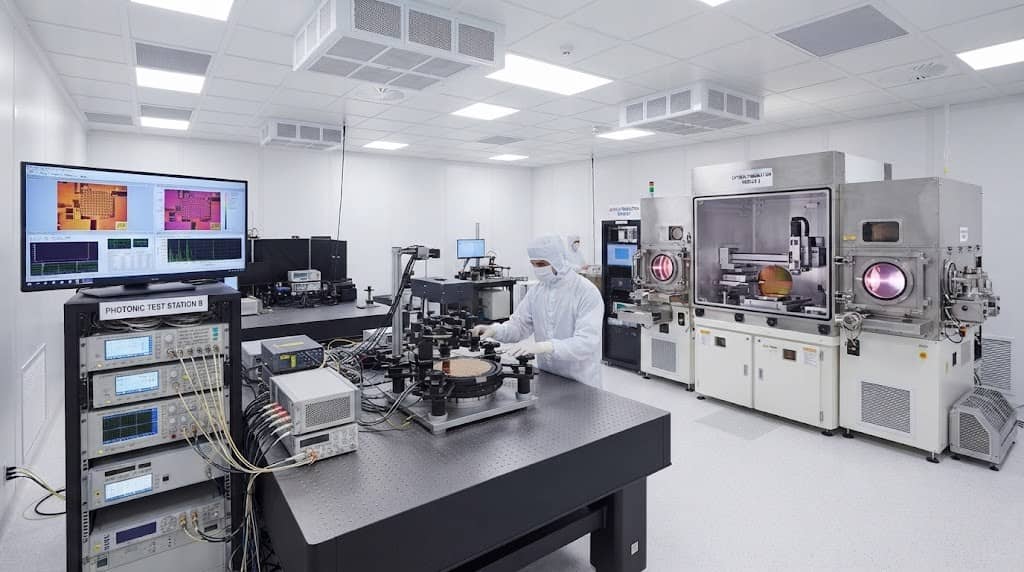
What Are TFLN and Silicon Photonics?
TFLN uses a thin lithium niobate layer integrated with optical waveguides and electrodes. Its strong electro-optic response makes it well suited to high-speed modulation, while its compact structure can reduce the size and drive requirements of lithium-niobate-based devices.
Silicon photonics uses silicon waveguides and semiconductor manufacturing processes to integrate optical functions on a compact chip. Its major strengths include dense photonic integration, mature fabrication processes and compatibility with large-scale optical transceiver manufacturing.
The distinction is therefore less about which material is “better” and more about which part of the optical system is the performance bottleneck. If the priority is highly efficient electro-optic modulation, TFLN can be attractive. If the priority is dense integration of waveguides, splitters, multiplexers and other photonic functions, silicon photonics has a strong advantage.
TFLN vs Silicon Photonics: Key Performance Differences
The most useful comparison starts with the parameters that directly affect system performance.
| Parameter | TFLN | Silicon Photonics |
| Electro-optic modulation | Excellent | High |
| Modulation bandwidth | Very high potential | High |
| Drive voltage | Low potential | Architecture-dependent |
| Linearity | Excellent | Application-dependent |
| Integration density | Moderate to high | Very high |
| Manufacturing maturity | Developing | Mature |
| High-volume production | Developing | Strong |
| Passive optical integration | Good | Excellent |
| RF/analog photonics | Particularly attractive | Application-dependent |
| Hybrid integration | Strong potential | Strong potential |
TFLN is particularly interesting when modulation bandwidth, Vπ, linearity and signal quality are major design considerations. Silicon photonics remains highly competitive where compactness, complex passive circuits and manufacturing scalability dominate.
Importantly, these characteristics do not mean that silicon photonics is unsuitable for high-speed communication. It is already widely used in high-speed optical systems. The question is whether the additional electro-optic performance offered by TFLN provides enough system-level benefit to justify its integration requirements.
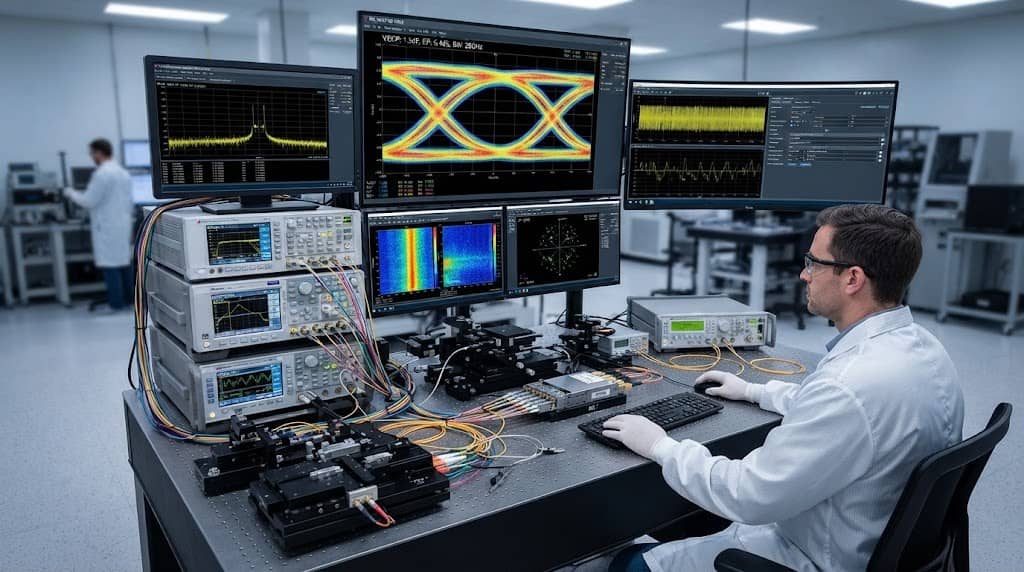
Which Platform Offers Better High-Speed Modulation?
For high-speed communication, the modulator must convert an electrical signal into an optical signal without becoming the limiting component of the link. Three parameters are particularly important: bandwidth, drive voltage and linearity.
1. Bandwidth
Higher bandwidth gives a modulator greater headroom for high baud-rate operation. This becomes increasingly important as optical links move beyond current 400G and 800G architectures toward 1.6T and future generations.
TFLN has attracted attention because its electro-optic properties support very high-speed modulation. NEON’s current TFLN product family includes devices specified for bandwidths up to 40 GHz, while its TFLN intensity modulator die documentation lists versions up to 67 GHz.
However, system bandwidth should not be judged from the modulator alone. Driver bandwidth, packaging, RF connectors, optical loss and signal integrity all influence the usable system data rate.
2. Drive Voltage
A lower half-wave voltage, or Vπ, can reduce the electrical swing required to achieve a given optical modulation depth.
This can matter in systems where driver power is a major part of the overall optical-link budget. NEON’s current TFLN intensity and phase modulator products specify Vπ values down to approximately 2–2.8 V, depending on the device configuration.
3. Linearity
Linearity becomes especially important for coherent communication, analog optical links and RF photonics, where distortion can directly affect signal quality.
This is an area where TFLN can provide a strong technical case. Rather than simply pursuing the highest possible bandwidth, engineers can evaluate bandwidth, Vπ and linearity together to determine whether a TFLN device provides a meaningful system-level advantage.

Where Does Silicon Photonics Have the Advantage?
TFLN’s modulation performance does not automatically make it the best platform for every optical system.
Silicon photonics has a major advantage in integration density and manufacturing maturity. Multiple passive and active optical functions can be combined into a compact photonic integrated circuit, making the platform attractive for optical transceivers and other high-volume applications.
For example, a system may need:
- optical splitters and combiners;
- wavelength multiplexing;
- compact waveguide routing;
- switching functions;
- integrated monitoring;
- electronic-photonic co-design.
Silicon photonics is particularly effective when these functions need to occupy a small footprint and be manufactured at scale.
Cost should also be evaluated at the system level, rather than simply comparing the cost of individual materials. Wafer processing, packaging, optical coupling, RF interfaces, testing and production volume can all influence the final cost. Therefore, silicon photonics can remain the more practical option when high integration density and volume manufacturing are more important than achieving the maximum electro-optic performance from a modulator.
TFLN vs Silicon Photonics for 800G and 1.6T Communication
The comparison becomes more interesting as optical communication moves toward higher data rates. For 800G optical communication, both platforms can play important roles. The key engineering questions include modulation format, baud rate, optical loss, electrical bandwidth, driver power and packaging.
At 1.6T, the available bandwidth and power budget become even more demanding. Small losses or electrical limitations in individual components can have a greater effect on the complete link. This does not mean that 1.6T systems must use TFLN. Instead, TFLN becomes increasingly attractive where the modulator is a critical performance constraint.
A useful way to approach the selection is:
- 800G: prioritize the complete transceiver architecture, integration density and power efficiency.
- 1.6T and beyond: place greater emphasis on modulator bandwidth, Vπ, RF performance and signal integrity.
This distinction also explains why TFLN and silicon photonics should not necessarily be viewed as competing technologies.
TFLN, Silicon Photonics or Hybrid Integration?
For many future optical systems, hybrid integration may provide a more practical path. This hybrid approach also connects with the broader role of TFLN modulators in photonics and optoelectronics integration, where modulation performance and system-level integration need to be considered together. Other materials can then perform functions better suited to their physical properties. For the receiver side, a high-speed photodetector can complement the modulator and complete the optical-to-electrical conversion path.
A simplified architecture could therefore look like:
- TFLN → high-speed modulation
- Silicon photonics → waveguides and passive optical integration
- III-V / other semiconductor materials → optical source
- InGaAs → telecom-band photodetection
This approach avoids forcing one material to perform every optical function.
It is also consistent with the direction of NEON’s current technology portfolio. The company offers TFLN die and modulator solutions in phase and intensity configurations, including versions with and without integrated light sources.
For engineers evaluating a TFLN modulator for a new optical architecture, the more useful question may therefore be: Which functions should be implemented on TFLN, and which should remain on silicon photonics or another photonic platform?
That question leads to a more realistic system-level design decision than simply selecting one material as the overall winner.
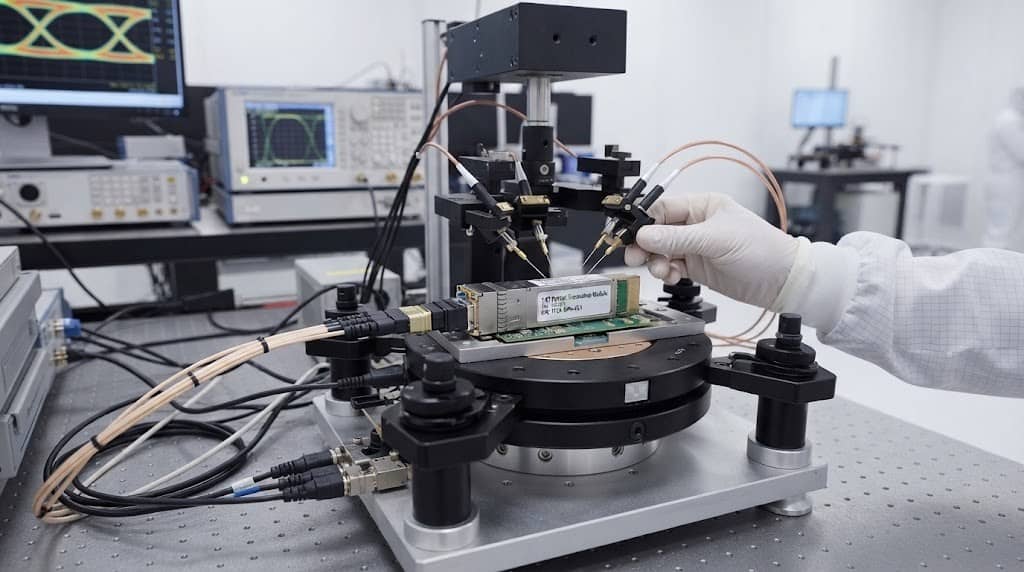
Which Platform Should Engineers Choose?
There is no single answer to TFLN vs silicon photonics.
Choose TFLN when the design places strong emphasis on:
- high-speed electro-optic modulation;
- low Vπ;
- high linearity;
- demanding RF or analog optical performance;
- future high-baud-rate communication.
Choose silicon photonics when the priorities are:
- high integration density;
- complex passive optical circuits;
- mature manufacturing;
- high-volume optical transceiver production;
- compact system architecture.
Choose hybrid integration when the system needs both high-performance modulation and dense photonic integration. For next-generation optical communication, the most effective platform may therefore be determined not by the material with the best individual specification, but by the one that delivers the best bandwidth, power, integration, manufacturability and total link performance together.
FAQ
Q1: Is TFLN better than silicon photonics for high-speed optical communication?
Not universally. TFLN is particularly strong for high-speed modulation, while silicon photonics offers advantages in integration and manufacturing scalability.
Q2: Why is TFLN suitable for high-speed optical modulators?
Its strong electro-optic response supports high modulation bandwidth and low drive voltage, making it attractive for demanding optical links.
Q3: Can TFLN and silicon photonics be integrated together?
Yes. Hybrid or heterogeneous integration can combine TFLN’s modulation performance with silicon photonics’ dense optical integration.
Q4: Is TFLN suitable for 800G and 1.6T systems?
It can be, particularly where modulator bandwidth, electrical drive requirements and signal quality are important system constraints.
Q5: What is the main advantage of silicon photonics?
Its major strengths include dense integration, mature manufacturing processes and suitability for scalable optical systems.
Q6: Will TFLN replace silicon photonics?
A complete replacement is unlikely. For many advanced systems, combining TFLN with silicon photonics may provide a more practical solution.