
How to Optimize High-Speed Photodetector Performance via Impedance Matching
In modern RF photonics and ultra-broadband optical communications, converting a light signal into a high fidelity electrical signal is only half of the challenge. With data rates approaching 400G, 800G, and beyond, the performance of a high speed photodetector is no longer simply a function of its internal quantum efficiency or transit time. The boundary where optics meets RF electronics becomes the ultimate bottleneck instead. For optical front-end application engineers, exact impedance matching is not an option in terms of optimization, but an absolute necessity to avoid catastrophic bandwidth degradation and signal distortion.
Understanding the High-Frequency Challenge in Photodetectors
When working with a standard, low-frequency photodiode, we often treat the output simply as a light-dependent current source obeying Ohm’s law. However, when deploying a high speed photodetector operating in the gigahertz (GHz) or millimeter-wave regimes, the laws of lumped-element circuits break down.
At these extreme frequencies, the electrical wavelength approaches the physical dimensions of the device packaging, bond wires, and printed circuit board (PCB) traces. The interconnected copper paths cannot be thought of as simple ideal conductors any longer, but must be seen as transmission lines, along which electrical signals propagate as guided electromagnetic waves. In the absence of a mathematically calculated boundary interface, these high frequency waves will experience severe impedance discontinuities that will adversely affect the integrity of the entire optical receiver path.
Why Does a High-Speed Photodetector Require Impedance Matching?
To maintain pristine signal integrity across a broad RF spectrum, a high speed photodetector relies on an environment where the source impedance, transmission line characteristic impedance, and load impedance are completely symmetrical—typically standardized to 50Ω. There are three primary physical drivers behind this requirement:
1. Eliminating Signal Reflection and Waveform Distortion
When an electromagnetic wave traveling down a transmission line encounters a change in impedance, a portion of the wave’s energy is reflected back toward the source. The severity of this reflection is dictated by the reflection coefficient (Γ):
Γ = (ZL − Z0) / (ZL + Z0)
When a high speed photodetector output (Z0) is connected to a mismatched post-amplifier load (ZL), the reflected waves travel back to the photodiode junction and recombine with the oncoming primary signal. The self-interference results in a high Voltage Standing Wave Ratio (VSWR) that leads to severe waveform anomalies:
- Ringing and Jitter: Parasitic oscillations distort the rising and falling edges of high-speed pulses.
- Eye-Diagram Closure: In digital links, these reflections manifest as severe Inter-Symbol Interference (ISI), closing the eye diagram and causing the Bit Error Rate (BER) to skyrocket.
2. Maximizing RF Power Transfer
The raw electrical signal generated by a high speed photodetector chip is inherently weak, often measured in microamperes (μA) or low milliamperes (mA). According to Jacobi’s Law (the Maximum Power Transfer Theorem), to transfer the maximum amount of active RF power from an electrical source to a load, the load impedance must equal the complex conjugate of the source internal impedance.
With tight impedance matching, we ensure that every microwatt of converted optical-to-electrical power is delivered cleanly to the post-amplifier rather than dissipated as heat or lost to reflections. This maximizes the overall signal-to-noise ratio (SNR) of the receiver module, and hence allows the detection of weaker optical pulses.
3. Overcoming the RC Time Constant Limit
Every photodiode architecture possesses an intrinsic junction capacitance (Cj), formed by the depletion region of the PIN or avalanche structure. This internal capacitance pairs with the external equivalent load resistance (RL) to create a parasitic low-pass RC filter. The fundamental 3-dB electrical bandwidth (f−3dB) of the device is rigidly bounded by this relationship:
f₋₃dB = 1 / (2π RLCj)
If the downstream system is poorly matched and presents a high effective load resistance (RL), the RC time constant inflates exponentially. This dampens the device’s transient response, turning a crisp, picosecond-range pulse into a smeared, sluggish waveform. Integrating a low-impedance matching network (such as 50Ω) minimizes RL, effectively driving down the RC delay and unlocking the true intrinsic speed of the high speed photodetector.
Common Impedance Matching Techniques in Modern RF Photonics
Implementing impedance matching for a high speed photodetector demands careful architectural planning at both the chip and layout levels:
- Internal On-Chip Matching: To suppress reflections at the earliest possible stage, many advanced high speed photodetector dies incorporate an integrated, monolithic 50Ω thin-film resistor in parallel with the photodiode junction. This shortens the distance between the current source and the match to sub-millimeter scales, neutralizing the inductive effects of long wire bonds.
- Coplanar Waveguide (CPW) PCB Layouts: Routing of signals must be done on the receiver board using special geometries such as Coplanar Waveguides with ground plane (CPWG) or microstrip lines. Engineers must calculate precisely the dielectric constant (εr), trace width, and substrate height to maintain a perfect 50Ω characteristic impedance from the photodetector pin to the SMA, K, or V-type coaxial RF connector.
- Active Transimpedance Amplifier (TIA) Co-Design: In integrated optical receiver designs, a high speed photodetector is often wire-bonded directly to a TIA. The TIA is engineered with a very low input impedance to absorb the photodetector current efficiently while maintaining high transimpedance gain, tightly controlling the interface mismatch.
The Impact of Mismatch on Real-World Applications
Neglecting impedance matching in a high speed photodetector setup has severe real-world operational ramifications across high-tech industries:
- Coherent Optical Communications: In 400G/800G coherent transceivers utilizing complex modulation schemes like PAM4 or QAM, minor impedance mismatches degrade the Error Vector Magnitude (EVM), completely corrupting the phase and amplitude information of the data stream.
- Aerospace & LiDAR Systems: Time of Flight (ToF) LiDAR systems employ a high speed photodetector for capturing sub-nanosecond laser returns. The mismatch-induced broadening of the pulses impacts the distance resolution, and accurate spatial mapping cannot be achieved.
- RF-over-Fiber (RFoF) & Metrology: Impedance mismatches in high frequency analog optical links lead to severe gain flatness variations over the target frequency band, which degrade the calibration of optical oscilloscopes and Time-Domain Reflectometry (TDR) test instruments.
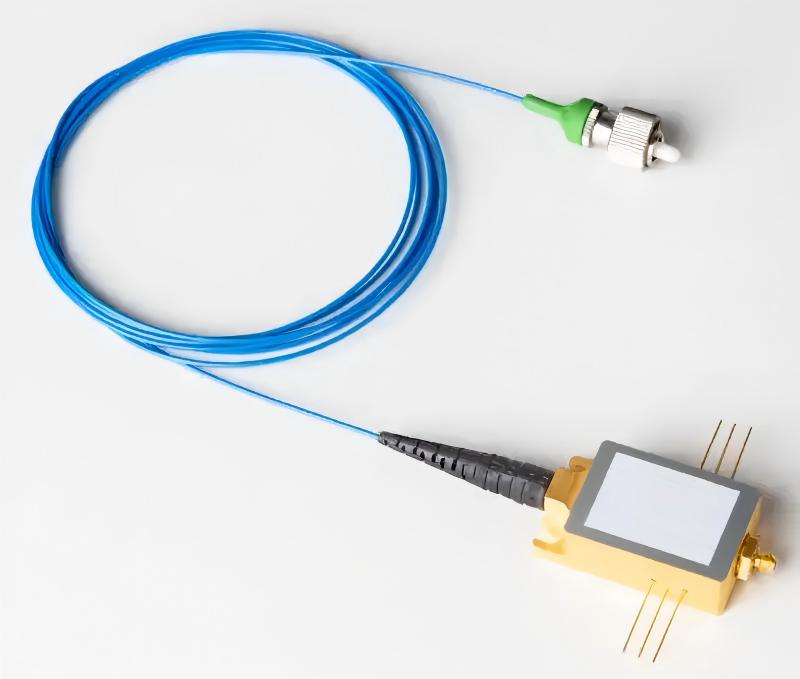
Technical Checklist for Engineers
When integrating a high speed photodetector into your next high frequency optical system, make sure your design checklist includes the following parameters:
- Check whether your high speed photodetector has an internal 50Ω termination or needs an external matching network.
- Simulate the PCB trace geometries with an electromagnetic field solver to ensure a continuous 50Ω characteristic impedance line.
- Minimize parasitic inductance (Lp) by making wire-bond lengths as short as physically possible between the high speed photodetector die and transmission lines.
- Select RF connectors rated for the maximum target frequency (e.g., 2.92 mm K-connectors for up to 40 GHz).
By systematically reducing RF impedance discontinuities you will ensure your high speed photodetector is operating at its real physical bandwidth limit and provides outstanding linearity and clean signal integrity to your downstream data processing systems.