
Optical Delay Line Precision Optimization: Engineering Guide to Drift Control
When we talk about shifting light in time—whether you are synchronizing ultra-fast pulses in a pump-probe setup, running coherence gates for OCT, or stabilizing modern phase-array LiDAR—everything boils down to one deceptively simple equation:
t=L/v=(n⋅L)/c
Here, t is your delay time, L is the physical path length, n is the refractive index of the medium, and c is the speed of light in a vacuum. It sounds straightforward, right? But if you are chasing sub-picosecond or femtosecond-level precision, this equation turns into a relentless battle against physics. At these scales, a tiny micron-level mechanical twitch or a fraction-of-a-degree temperature shift changes your optical path difference (OPD) enough to completely trash your data.
To build or select the right optical delay line, you need to know exactly where your error budget is bleeding out. Let’s break down the core physical bottlenecks and environmental troublemakers that dictate optical delay line precision, and look at how we can mitigate them in real-world bench environments.
Micro-Mechanisms vs. OPD Stability
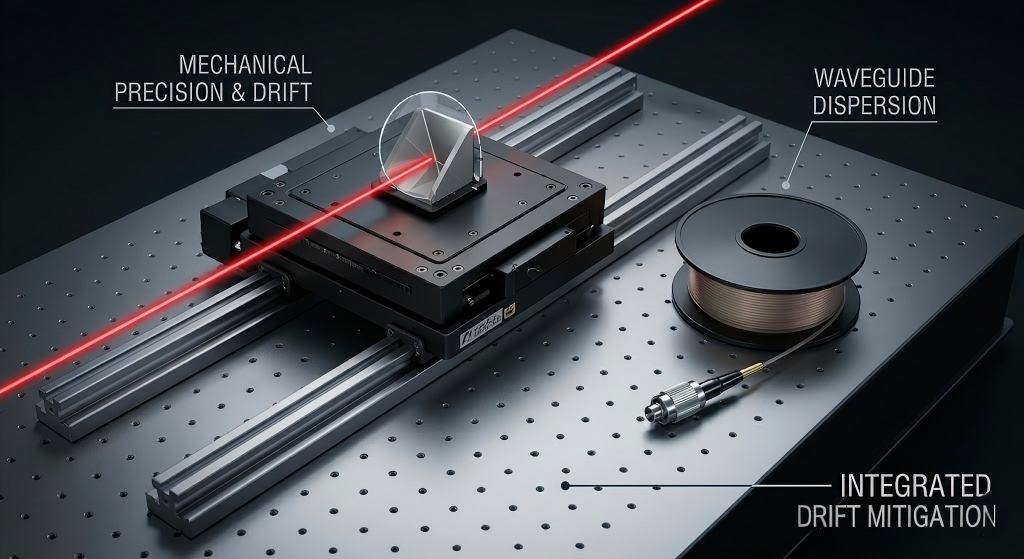
If you are working with a free-space motorized optical delay line, you are relying on physical movement to alter the optical path. That means your timing precision is directly handcuffed to your mechanical infrastructure.
Mechanical Resolution & Actuator Hysteresis
To put things in perspective, let’s do some quick back-of-the-envelope math. If your project demands a timing resolution of exactly 1 fs (one femtosecond), the physical displacement (ΔL) your motion stage needs to execute is:
ΔL=c⋅Δt≈3×10⁸m/s×10−15s=300 nm
Because light has to travel to your reflector and back, a 300 nm change in the total optical path actually means your physical stage only needs to move a mere 150 nm.
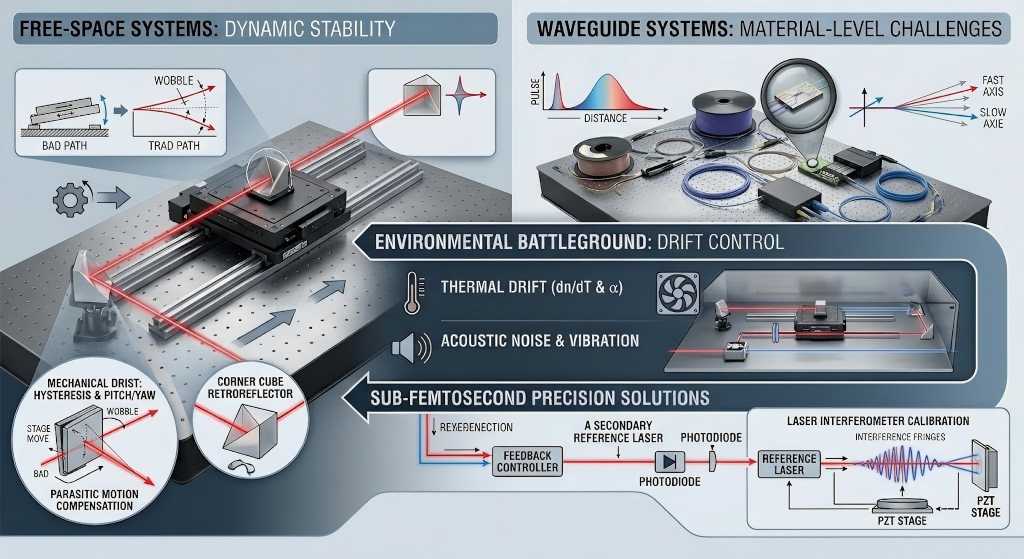
Standard stepper motors or even high-end DC brushed servos simply won’t cut it here due to backlash and mechanical hysteresis. When you reverse the direction of your stage, micro-gaps in the lead screw or mechanical bearings cause a dead zone where the motor turns, but the stage stays put. For true sub-picosecond repeatability, you absolutely have to shift to closed-loop linear glass scales or direct-drive piezoceramic (PZT) actuators that can resolve nanometer-level increments without skipping a beat.
Guiderail Parasitic Motion (Pitch & Yaw) and Alignment Drift
Another hidden killer is the straightness of your travel guide. No rail is perfectly flat. As your stage glides along the track, it undergoes tiny rotational deviations: pitch (tilting up and down) and yaw (swiveling left and right).
If your stage pitches by just a few microradians over a 100 mm travel range, the reflected beam begins to angularly drift. Not only does this geometric deviation introduce subtle, non-linear errors into your expected OPD, but it also causes spatial walk-off. By the time that drifted beam tries to couple back into a single-mode fiber or hit a tiny photodetector at the end of your bench, your coupling efficiency tanks, translating your mechanical timing error into a messy amplitude modulation problem.
Waveguide & Fiber ODLs: Material-Level Error Sources
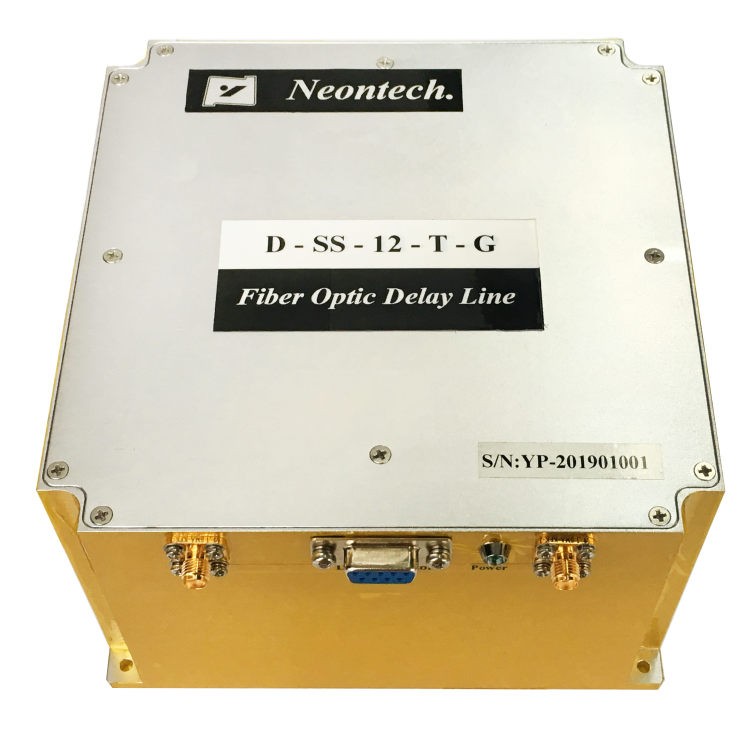
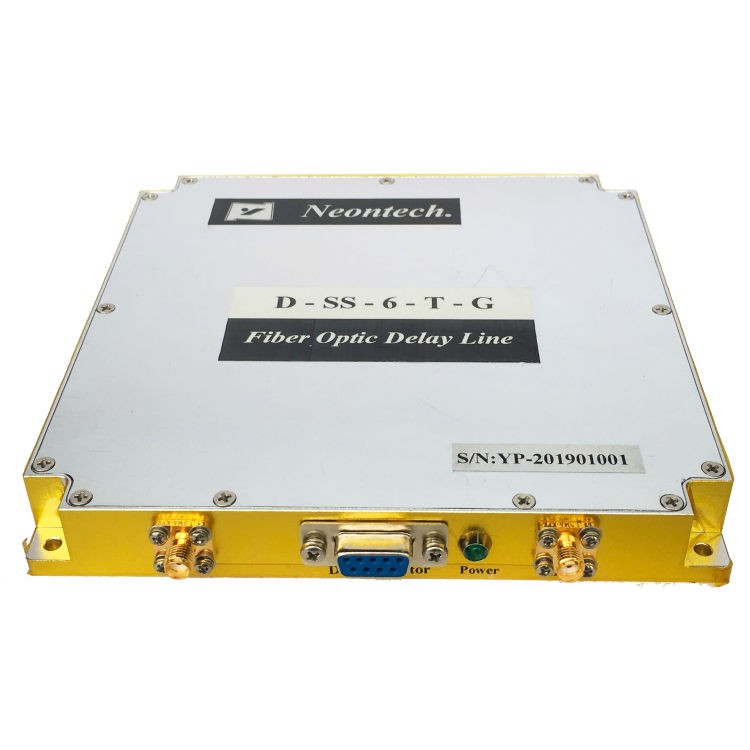
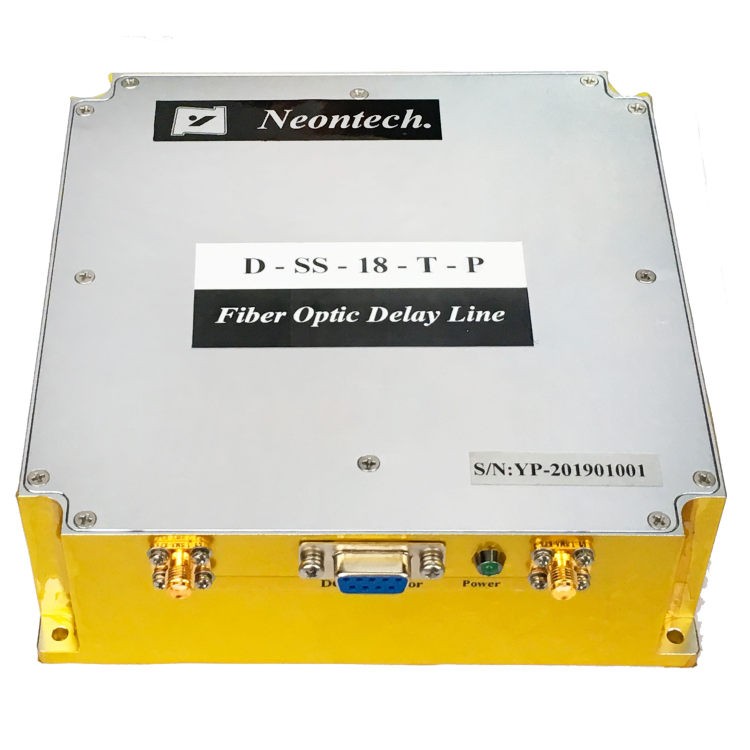
When you ditch the moving parts and opt for a fiber-optic or silicon photonic (SiPh) integrated switch-matrix optical delay line, you trade mechanical wear for material physics headaches.
Chromatic Dispersion and Pulse Broadening in Ultra-Wideband Systems
In a dielectric medium like glass or silicon, the refractive index isn’t a fixed number—it is a variable that changes depending on the wavelength of light passing through it (n(λ)). This is chromatic dispersion. If you are running an ultra-fast laser with a broad spectral bandwidth (say, a 100-fs pulse at 1550 nm), the different spectral components of that pulse travel at different group velocities (vg).
As the light propagates down a long fiber optical delay line, the pulse broadens in the time domain. The front of the pulse separates from the back of the pulse. This group delay dispersion (GDD) muddies your temporal edge, making it incredibly difficult to define the exact arrival time of your optical trigger.
Polarization Mode Dispersion (PMD) and Birefringence Management
Standard single-mode fiber (like SMF-28) looks symmetrical from the outside, but internal manufacturing stresses and external bending introduce random asymmetry. This causes structural birefringence, meaning the fiber exhibits two distinct, orthogonal indexes of refraction (nx and ny).
As light travels down the fiber, the component aligned with the fast axis pulls ahead of the component on the slow axis. This split is known as polarization mode dispersion (PMD). If your input polarization state drifts due to a cable being nudged on the desk, your delay time drifts along with it. To lock this down, high-precision fiber optical delay line systems must be built entirely out of polarization-maintaining (PM) fiber, forcing the light to stay strictly coupled to a single, well-defined axis.
Managing Environmental Variables: The Battle Against Drift
You can buy the most expensive stage on the market, but if your lab’s HVAC system cycles on and off, your precision goes out the window. Environmental drift is the primary enemy of long-term stability in any optical delay line.
Thermal Drift Control: Quantifying the dn/dT and α Impact
Temperature variations mess with both the physical length (L) via thermal expansion (α) and the refractive index (n) via the thermo-optic coefficient (dn/dT).
Let’s look at a standard silica fiber. It has a thermal delay coefficient (TCD) of roughly 40 ps per kilometer for every single degree Celsius of temperature change (40 ps/(km⋅ ℃)). If you have a fixed fiber loop designed to give you a long 50 ns delay, that requires about 10 meters of fiber. A minor 2 ℃ ambient temperature swing in the room will cause your baseline delay to drift by:
Drift=40 ps/(km⋅ ℃)×0.01 km×2 ℃=0.8 ps=800 fs
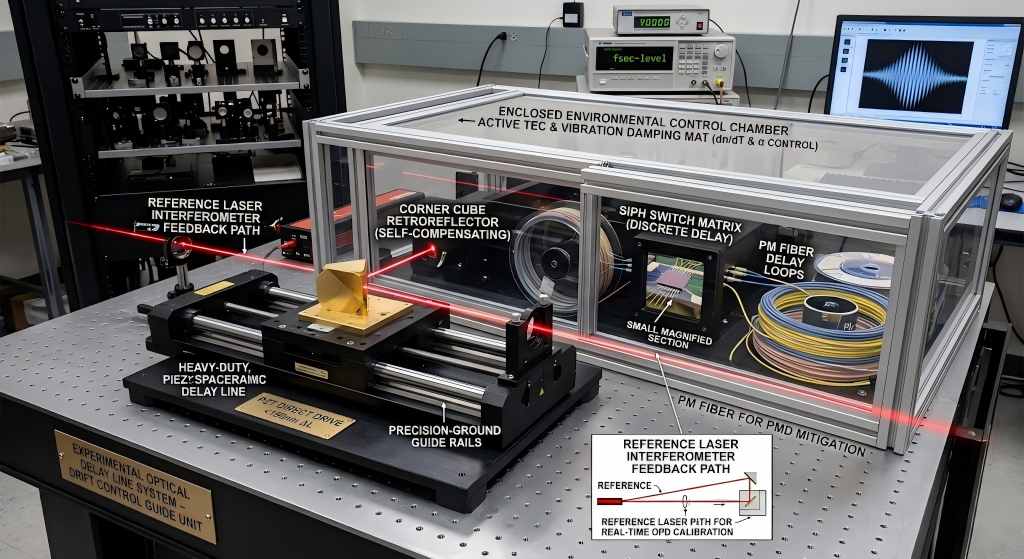
In the femtosecond world, an 800-fs drift is a catastrophic error. For free-space setups, temperature swings alter the density of the air itself, shifting the air’s refractive index. To beat this, engineers either house their setups inside strict, actively-cooled thermoelectric coolers (TEC) enclosures or switch to specialized zero-TCD fibers that mix dopants to cancel out the thermo-optic effect.
Acoustic Noise and Mechanical Vibrations as Phase Disruptors
Acoustic energy from an overhead air vent or low-frequency rumble from a nearby vacuum pump acts as a dynamic physical strain on your optical path. In fiber, these sound waves dynamically compress and stretch the glass waveguide, modulating the optical phase at acoustic frequencies. In free-space systems, these vibrations cause subtle mirror rattling. Shielding your optical delay line with physical damping mats, heavy optical tables, and acoustic enclosures isn’t an afterthought—it’s mandatory for survival.
Engineering Solutions for Sub-Femtosecond Precision
When you need to squeeze out every drop of performance, standard optomechanical layouts won’t cut it. You have to design defensively.
Retroreflector Design: Corner Cube vs. Cat’s Eye Systems
To combat the parasitic pitch and yaw motion of translation stages, seasoned engineers avoid using simple flat mirrors. Instead, they implement a retroreflector like a corner cube or a cat’s eye lens-mirror configuration.
A corner cube uses three mutually perpendicular reflective surfaces to ensure that no matter what angle the light enters, the exit beam emerges exactly parallel to the input beam. If your moving stage wobbles slightly midway through its run, the corner cube automatically compensates for the angular wobble, preventing spatial beam walk-off and preserving your downstream alignment.
Active Interrogator Feedback & Laser Interferometer Calibration
For systems requiring long-term absolute tracking, you cannot rely blindly on the motor encoder’s readout. Advanced setups co-align a secondary, continuous-wave reference laser (like a highly stabilized HeNe) along the exact same physical path as your signal beam. By monitoring the interference fringes of this reference beam in real-time, an online calibration system can detect path length shifts down to a fraction of an optical wavelength, instantly adjusting a fast-acting PZT stage to counteract any environmental drift before it impacts your primary measurement.
Optical Delay Line Selection Matrix for High-Precision Applications
Choosing the right optical delay line topology requires making trade-offs between speed, space, and stability. There is no silver bullet.
| Optical Delay Line Type | Max Delay Range | Typical Resolution | Primary Error Bottleneck | Common Mitigation Strategy |
| Free-Space Motorized | Long (1 ns to >10 ns) | Very High (<1 fs with PZT) | Stage pitch/yaw, air turbulence, mechanical wear | Implement corner-cube retroreflectors; seal the optical path in a localized box. |
| Fiber-Optic (Switched Network) | Extra Long (>1 \mus) | Discrete Steps (Depends on switch speed) | Thermal drift (TCD), polarization splitting (PMD) | Use PM fiber; pack entire fiber spool into an actively controlled oven/TEC chamber. |
| Silicon Photonic (On-Chip) | Short (<1 ns) | Continuous / Variable | High insertion loss, thermal cross-talk | Use localized micro-heaters for phase-shifted active tuning loops. |
Conclusion & Actionable Takeaways
At the end of the day, achieving peak performance with an optical delay line comes down to building a rigorous, honest error budget. You cannot simply look at the spec sheet of a translation stage and assume its minimum step size equals your real-world timing accuracy.
When designing your next system, map out your mechanical tolerances, quantify your local thermal fluctuations, and account for material dispersion early in the lifecycle. By isolating your optical path from environmental noise and utilizing self-compensating optics like retroreflectors, you can successfully tame the drift and push your system’s timing precision deep into the sub-picosecond regime.