
InGaAs Photodiode Arrays: High-Speed Architecture and Industrial Applications
The SWIR detection field has transformed due to advances in Indium Gallium Arsenide (InGaAs) technology. SWIR detection ranges from 900nm to 1700nm. While Si-based sensors lose sensitivity after 1100nm, InGaAs provides high quantum efficiency and low noise at (room) telecommunications and molecular spectroscopy bands. The transition from single-point sensors to photodiode array detector has provided multidimensional data acquisition, capturing data in both space and time.
Material Physics and the Role of the InGaAs Sensor Manufacturer
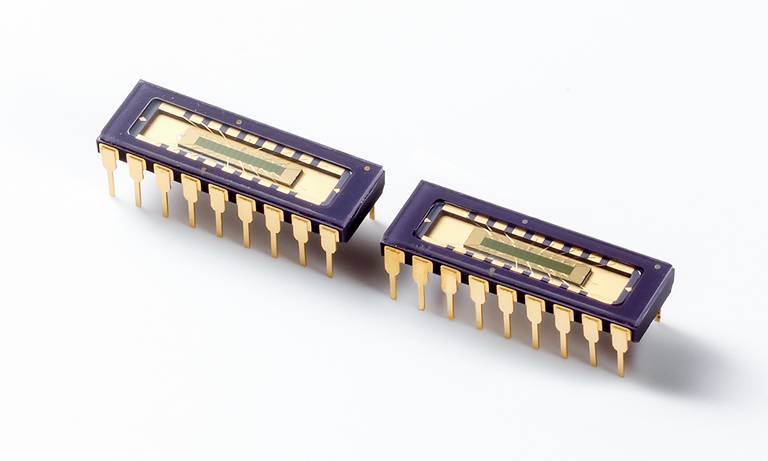
Any photodiode array detector’s performance starts with the quality of the epitaxial growth. InGaAs is a ternary III-V compound semiconductor. An InGaAs sensor manufacturer can set the bandgap of the material by calibration of the Indium to Gallium ratio to meet particular application needs.
Standard InGaAs that is lattice-matched to Indium Phosphide (InP) substrates has a composition of approximately 53% Indium and 47% Gallium (In0.53Ga0.47As). This composition offers a peak detection ability at 1.55 μm, which corresponds to the standard wavelength used in long-haul fiber optic communication. When detection is needed at 2.2 μm or 2.6 μm, then “extended InGaAs” is used. The problem is that with more Indium, there is a lattice mismatch that produces an increase in dark current and pixel defects. Because of this, it is very important to choose only the best InGaAs sensor manufacturers, as they will need to perform buffer layer design to eliminate the crystalline dislocations that worsen the SNR (Signal-to-Noise Ratio).
Engineering a High Speed Photodetector Array
The demand for real-time monitoring and high-throughput screening has driven the development of the high-speed photodetector array. Achieving high bandwidth in an array format requires a multidisciplinary approach involving semiconductor physics and advanced packaging.
1. Capacitance and Response Time
The response speed of an InGaAs photodiode array is primarily limited by the RC time constant and the carrier transit time.
- Junction Capacitance (Cj): To increase speed, the junction area of each pixel must be minimized. However, smaller pixels collect fewer photons, creating a trade-off between speed and sensitivity.
- Depletion Layer Width: A thicker depletion region reduces capacitance but increases the time it takes for photo-generated carriers to reach the electrodes.
2. Readout Integrated Circuit (ROIC) Integration
The process of retrieving analog signals from pixel components creates a major constraint in high-speed photodetector arrays. Modern arrays use hybridized structures where the InGaAs photodiode layer is bonded to a CMOS Readout Integrated Circuit (ROIC) using flip-chip bonding. The technique uses indium bumps to establish a direct vertical pathway that connects each photodiode with its matching transimpedance amplifier (TIA) on the CMOS chip. The design reduces unwanted inductive and resistive elements, which enable frame rates to surpass multiple kilohertz.
Performance Metrics of the Photodiode Array Detector
Engineers evaluating the performance of a photodiode array detector consider a number of metrics that characterize the boundaries of performance for precision measurements.
- Quantum Efficiency (QE): This is the portion of incoming photons that gets converted into electrons. A good quality InGaAs photodiode array typically has a QE of more than 80% for the 1.0–1.6 μm range.
- Specific Detectivity (D*): This is the metric of performance of the detector divided by its area and the noise-equivalent power. This facilitates the comparison of a number of array designs irrespective of the size of the pixels.
- Pixel Operability and Uniformity: In an array that consists of 512 or 1024 pixels, small differences in the thickness of the materials or in the doping may result in Non-Uniformity (NU). High-end detectors are designed with Non-Uniformity Correction (NUC) algorithms to achieve a linear and uniform response across the entire array.
Industrial and Scientific Applications
The integration of high-speed photodetector array technology has revolutionized several key sectors by allowing for “snapshot” data acquisition where mechanical scanning was previously required.
1. Optical Coherence Tomography (OCT)
In medical imaging, especially in the field of ophthalmology, SD-OCT (Spectral Domain Optical Coherence Tomography) employs a linear InGaAs photodiode array to capture interference patterns. The array detects all wavelengths in the interference spectrum at the same time, which makes it possible to create 3D cross-sectional images of the retina in milliseconds. This rapid imaging is critical in avoiding capture blindness from involuntary eye movements during imaging.
2. Near-Infrared (NIR) Spectroscopy
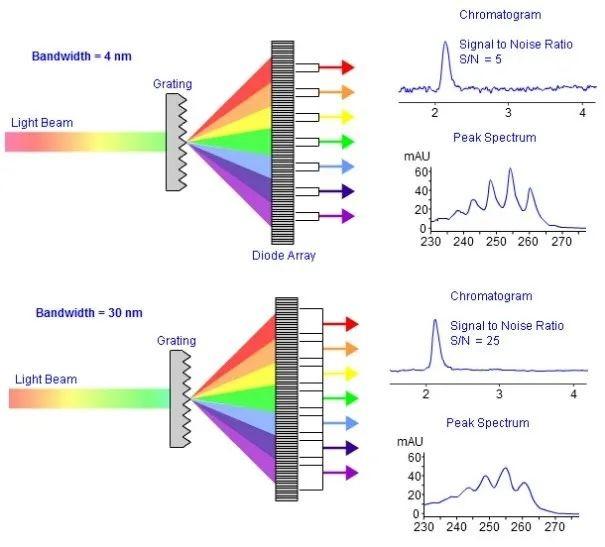
The photodetector array is the primary component in the latest generation of spectrometers in the food and pharmaceutical industries. In this application, the array is positioned at the focal plane of a grating. When a sample, e.g., a grain of wheat or a chemical powder, is analyzed, different wavelengths of light, varying based on the sample, are captured by different pixels in the array. As a result, it is possible to detect the moisture content, amount of protein, and level of chemical impurities in the sample non-destructively.
3. Free Space Optical (FSO) Communication
A high-speed photo detector array is utilized for both receiving data and tracking beams for communication between satellites and the ground or between satellites. Due to its array format, the system can identify the spatial location of a laser beam and therefore perform active alignment corrections and receive high data rate streams.
Future Directions in Array Technology
With the drive for miniaturization and cost minimization for the supply chain, InGaAs sensor manufacturers are concentrating their efforts on wafer-level packaging and silicon photonics integration.
- Wafer Scale Integration: The current world-first approach is to grow InGaAs layers on silicon. Should that be accomplished, infrared sensors could be integrated and fabricated in volume as any other silicon device using CMOS fabrication technologies, drastically reducing the cost for InGaAs sensors.
- High-Density Arrays: A key challenge for the next generation designs of photodiode array detectors is to increase the number of pixels in the array from 1K to 4K and beyond while keeping the array size small. In order to achieve this, the pixel pitch must be below 10 μm, which creates additional challenges for precision in flip chip bonding and thermal management.
- Wider Dynamic Range: New designs of ROICs are utilizing what is called digital pixel technology, which means that the analog-to-digital conversion is done within the pixel. This produces less noise and greatly improves the dynamic range, thereby improving the ability of the detector to see detail in very bright and very dark areas of the same
The InGaAs photodiode array combines advanced materials science and systems engineering and exemplifies state-of-the-art optoelectronic engineering. High-speed photodetector arrays, the result of collaboration between InGaAs sensor manufacturers and electronic circuit designers, have become important components of medical diagnostic devices, industrial automation, and worldwide telecommunications. Ongoing advances in fabrication techniques will continue to improve the accessibility and functionality of these photodiode array detector systems and drive innovation in the infrared detection systems.